

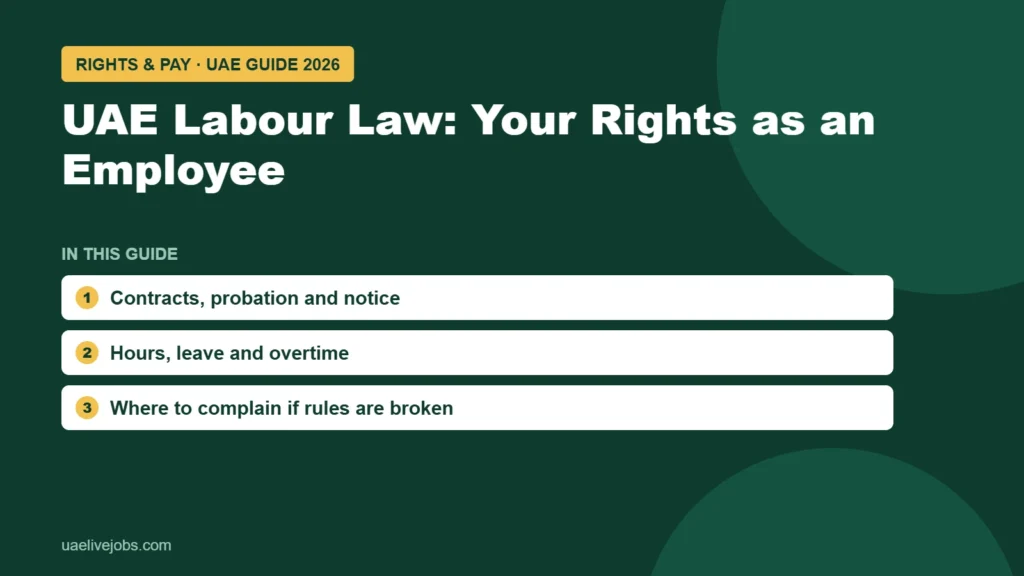
UAE labour law for private-sector staff is mainly one document: Federal Decree-Law No. 33 of 2021. It came into force in February 2022 and replaced the old 1980 law. If you work for a company on the mainland, or in most free zones, this is the law that decides your contract, your hours, your leave and what you are owed when you leave.
This guide is a map. It gives you the main rules in one place, in plain words, and points you to a detailed guide for each topic. It is not a copy of the law, so for a real dispute check the official text or speak to MOHRE.
Who the law covers, and who it does not
- Covered: employees of private-sector companies, including most free zones.
- Not covered by this law: federal and local government staff, domestic workers, and employees inside the DIFC and ADGM financial centres. They follow their own rules.
Free zones can add their own policies, so read your contract along with the law.
The main rules at a glance
| Topic | What to know | More detail |
|---|---|---|
| Contract | Contracts are fixed-term. Old unlimited contracts had to be converted to fixed-term within a year. | Contract types |
| Probation | Up to 6 months, and it cannot be extended. Time in probation counts as service if you stay. | Probation rules |
| Working hours | 8 hours a day or 48 a week. Two hours less each day in Ramadan. | Overtime pay |
| Overtime | No more than 2 extra hours a day. Pay is your hourly rate plus 25%, or plus 50% between 10 pm and 4 am. | Overtime pay |
| Leave | 30 days of annual leave a year, up to 90 days of sick leave, 60 days of maternity leave and 5 days of parental leave. | Annual leave |
| Notice | Usually 30 to 90 days, as written in your contract. | Notice period |
| End of service | Gratuity is paid on basic salary, for service of one year or more. | Gratuity calculator |
| Pay | Salary must be paid on time, and deductions are limited. | Salary deductions |
Rights people often do not know they have
- Your employer cannot keep your passport. See what to do if they do.
- You should not pay recruitment fees. The cost of hiring you sits with the employer. Our guide on recruitment fees explains this.
- Harassment and bullying at work are against the law. The steps are in our workplace harassment guide.
- Your payslip and salary record matter. Look at how to read a payslip and how the Wage Protection System tracks payment.
Leaving a job
How you leave decides what you get. If you resign and serve your notice, you normally keep your end-of-service gratuity. If the employer ends your job without proper reason, the rules in termination without notice apply. Before a visa is cancelled, check our guide to work visa cancellation, and if you are moving to another employer read about the NOC and job change rules.
If your employer breaks the rules
- Write it down. Keep your contract, payslips, bank statements and any messages.
- Raise it with HR in writing, politely and with dates.
- Call MOHRE on 80084 or use its app and website to file a complaint. Our MOHRE complaint guide shows each step.
- If it is not settled, MOHRE refers the case to court after 14 days. For claims of AED 50,000 or less, MOHRE can give a final decision itself, and either side can appeal within 15 working days. More in UAE labour disputes.
Time limits apply to claims, so do not wait many months before you act.
Is there a minimum wage?
There is no general minimum wage for private-sector workers in the UAE. Since 1 January 2026 there is a minimum of AED 6,000 a month for Emirati employees in the private sector. It does not cover expatriates.
Where this information comes from
Working hours, overtime and leave details come from the UAE Government portal pages on working hours, types of leave and employment contracts. The dispute process follows reporting by Gulf News, and the Emirati minimum wage follows EY’s tax news summary. Rules change, so check MOHRE before you rely on a detail. This is general information, not legal advice.