

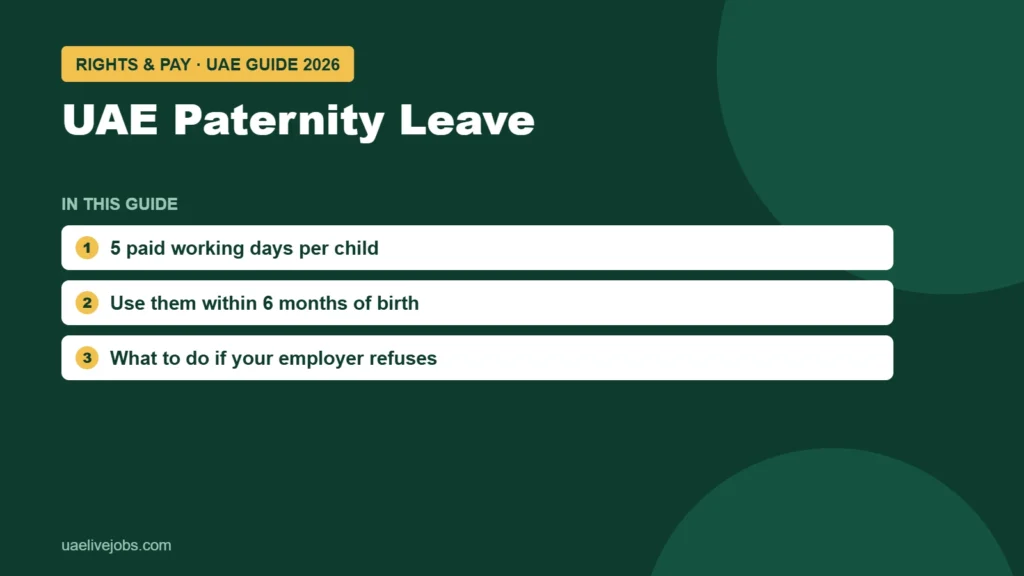
If you work in the UAE private sector and your child is born, you can take 5 working days of paid leave. You can use them any time from the day the baby is born until the child is six months old. Your employer pays your normal salary for those days, and they do not come out of your annual leave.
The law calls this parental leave, not paternity leave, because it is open to both parents. The five days are given per child. If your wife has twins, ask your HR team how they count it, because the official page speaks about “each child”.
Who gets it
The rule sits in the UAE Labour Law (Federal Decree-Law No. 33 of 2021) and covers employees of private-sector companies. It does not depend on your nationality. The government page for leave types lists no minimum months of service, so a new joiner is not excluded by that page. Probation is a different question, and your contract is the place to check it.
Three groups follow different rules:
- Federal and Dubai government employees. Government HR laws are separate. Ask your department.
- DIFC and ADGM staff. These financial free zones have their own employment laws.
- Domestic workers. They fall under a different law.
Other free zones usually follow the federal law, but some add their own policy. A quick message to HR saves guessing.
How the 5 days work
| Point | What the rule says |
|---|---|
| Length | 5 working days per child |
| Pay | Full pay, same as a normal working day |
| Window | From the child’s birth until the child is 6 months old |
| Who can take it | Fathers and mothers |
| Counts against annual leave? | No, it is a separate leave |
The page does not say whether you must take the five days in one block or can split them. Most HR teams allow both if you ask early. Get the answer in writing before the birth if you can.
A simple example
Imran earns AED 7,200 a month. His daughter is born on a Tuesday. He takes five working days off and returns the next week. His salary that month is still AED 7,200. Nothing is cut and his annual leave balance stays the same.
How to ask for it
- Tell your manager and HR as soon as the due date is near. Do not wait for the birth.
- Ask which dates they prefer and whether they accept split days.
- Keep the proof of birth ready. Employers commonly ask for the hospital notification or the birth certificate, but the law page does not list a document, so ask what your company needs.
- Apply through your normal leave system or in writing, and keep a copy.
- Check your payslip for that month to confirm no deduction was made.
If your employer says no
A refusal is not the end. Start with a polite written request that names the law and the five days. If that fails, you can complain to the Ministry of Human Resources and Emiratisation (MOHRE) on 80084 or through its app. Our guide to the MOHRE complaint process shows the steps, and UAE labour disputes explains what happens if it goes further.
Common questions
Can I add annual leave to the five days?
Yes. Many fathers take the five days and then add part of their annual leave for a longer break. That needs your employer’s approval, as annual leave always does.
Is it counted as a holiday if a public holiday falls inside?
Public holidays are paid anyway. If one falls inside your five days, ask HR whether it counts as one of the five. Our guide on public holiday pay covers how those days are treated.
What if my baby is born abroad?
The law page does not limit the leave to births in the UAE. Share the foreign birth certificate with HR and agree the dates before you travel.
Can my employer make me take unpaid leave instead?
Not for these five days. If you need more time than the law gives, you can ask for unpaid leave, and that is a separate agreement.
Where this information comes from
The leave rules come from the UAE Government portal page on types of leave in the private sector. That page describes parental leave as 5 working days, available to both parents, from the birth until six months. It is a short summary, so confirm the details with MOHRE or your HR team before you plan around exact dates. This is general information, not legal advice.