
Annual leave is a statutory employment benefit for mainland private sector employees, not a discretionary favour from your employer. The rules can still feel confusing when you’re new to a job, planning travel, resigning, or checking your exit pay.
This guide focuses on mainland private-sector employment under the federal framework. Your employment contract may provide better terms, while DIFC, ADGM, and other free-zone regimes may follow different rules, so check which system applies before booking tickets or signing a settlement.
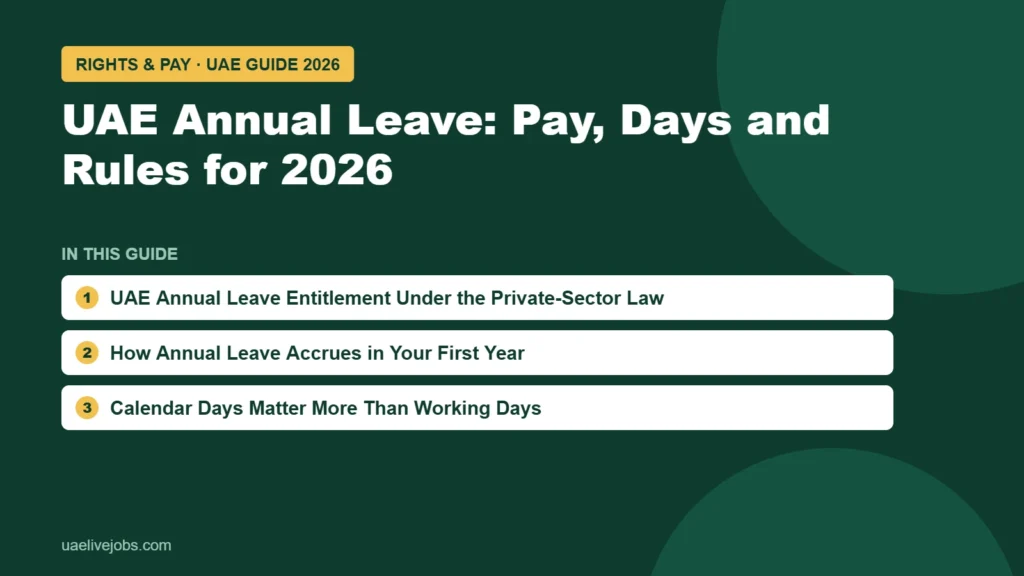
UAE Annual Leave Entitlement Under the Private-Sector Law
Federal Decree-Law No. 33 of 2021 is the principal federal law for mainland private sector employees. Article 29 provides annual leave with full wage. The Executive Regulations provide additional calculation details. You can review the wording in the official UAE Labour Law text.
The minimum annual leave entitlement depends on your continuous service with the employer.
| Length of Service | Minimum Annual Leave |
|---|---|
| Six months or less | No statutory annual leave entitlement yet |
| More than six months, under one year | 2 days for each completed month |
| One year or more | 30 calendar days per year |
These are statutory minimum rights. A more favourable employment contract can provide additional leave, but it cannot reduce the legal minimum. An employer may approve leave before the statutory threshold, but this doesn’t change when the statutory entitlement begins.
After You Complete One Year
Once you complete one year of service, you are entitled to 30 days of paid annual leave each year. Your leave salary remains due during the approved period.
The total includes weekends and agreed rest days within your leave period. This catches many employees by surprise. If your approved leave starts on Monday and lasts 10 days, the Friday, Saturday, and Sunday inside that period normally count too.
Between Six Months and One Year
If you have worked for more than six months but less than one year, you earn two days of leave for each completed month.
For example, if you have completed eight months of service, your entitlement is:
8 months x 2 days = 16 days
Your HR system may show leave accruing monthly. Check that it matches your joining date and employment records.
How Annual Leave Accrues in Your First Year
The first six months can feel unclear because many employees assume leave starts building from day one. The probation period and statutory leave rules are separate. Passing probation does not automatically grant 30 days, since statutory leave starts after more than six months under mainland rules.
That does not mean you cannot request time off before then. Your employer may approve unpaid leave, paid leave under company policy, or annual leave in advance. Check whether your employment contract provides more generous terms, and get the approval in writing.
Annual Leave During Probation
Probation can last up to six months under UAE rules. During this time, an employer may approve paid leave under policy, leave in advance, or unpaid leave.
It is not an automatic right to take annual leave whenever you want during probation. Ask early, especially if you have travel plans, a family event, or a medical appointment abroad.
If the employer approves leave during the probation period, keep the email, HR portal record, or signed leave form. These records can prevent confusion if your balance changes.
Leave After You Pass Probation
Passing probation does not instantly mean you receive 30 days. Your leave amount still follows your total service period, counted from your joining date.
Someone who joined on 1 January and passes probation in July has completed six months. They begin earning two days for each month after that point until they complete a full year.
Your probation end date and your annual leave anniversary are not always the same thing. Check both dates before calculating your balance.
Calendar Days Matter More Than Working Days
For most mainland private-sector employees, the 30-day entitlement is generally expressed in calendar days, not 30 working days.
This matters when planning a long trip. A two-week absence may use 14 calendar days, even if your normal schedule has only five or six working days each week.
Legally prescribed or agreed rest days are included in the annual leave period. Weekends falling inside approved leave are normally part of those calendar days, not added back later.
A Simple Leave-Day Example
Suppose your approved leave runs from 1 August to 15 August. Counting both dates, that is 15 calendar days.
Even if your usual days off fall during that period, the leave request will generally deduct 15 days. Check the approved start and end dates and the employer’s written policy with HR before booking travel.
Payroll or HR software may display the deduction differently. The law is the starting point, but your employment contract may provide a better arrangement.
Annual Leave Salary: Full Wage While You Are Employed
Approved annual leave during active employment is paid as leave salary, not as a termination payment. Article 29 provides annual leave with full wage, based on the terms in your employment contract and applicable law.
Your leave salary usually follows the wage basis used for regular payroll. Fixed allowances, such as housing or transport, may form part of your regular wage package, but discretionary benefits, flight allowances, reimbursements, and one-off payments may follow separate rules. Payroll should confirm how other fixed allowances are treated.
Check your MoHRE employment contract and recent payslips. A large difference between your basic salary and total monthly wage matters when leave is paid or employment ends.
How to Check Your Leave Salary
If your monthly wage is AED 6,000 and you take 10 days of approved annual leave, your leave salary should not be reduced simply because you were away from work.
For monthly-paid employees, companies commonly use a daily payroll calculation based on the monthly wage. The exact payroll presentation may differ, but approved annual leave should still be paid as leave salary.
Before leave begins, confirm these points with HR:
- Your approved start and return dates are correct in the HR portal.
- Your leave is marked as paid annual leave, not unpaid leave.
- Your salary transfer date will not be affected by a payroll cut-off.
- Any flight allowance or discretionary benefit is checked separately, because it may follow a different company policy.
The UAE Government’s private-sector leave guidance is a useful reference if you need to compare your employer’s policy with the legal minimum.
Unused Leave and Final Settlement Are Different
Leave salary while you’re still employed is different from annual leave encashment when employment ends.
When you resign, are terminated, or your fixed-term contract ends, your employer must include any legally due unused annual leave in your final settlement. The calculation for this balance uses the statutory basic-wage basis, usually shown as basic salary, rather than your total wage.
This is one of the most common causes of disagreement at the end of a job.
Final Settlement Example
Imagine your employment contract shows:
- Basic salary: AED 3,500
- Housing allowance: AED 1,500
- Transport allowance: AED 500
- Total monthly wage: AED 5,500
Here, AED 3,500 is the statutory basic wage. Housing and transport are fixed allowances, but they aren’t automatically included in this annual leave encashment calculation.
If you take approved annual leave during employment, your pay normally follows the wage arrangement that applies to your job. If you leave with unused annual leave, the final settlement uses the AED 3,500 basic salary.
For 10 unused days, a simple 30-day basis calculation would be:
AED 3,500 / 30 x 10 = AED 1,166.67
This 30-day example is illustrative, not a universal rate for every case. Your actual settlement can also include salary due up to your last working day, notice-period adjustments, deductions allowed by law, and end-of-service benefits where applicable. For the gratuity part of the same settlement, use our gratuity calculator.
Check the Final Settlement Before Signing
Ask for an itemised statement before signing your final settlement. It should show your basic salary, unused leave days, daily rate, outstanding salary, and any deductions.
Don’t sign a paper that says you received all dues if you haven’t seen the calculation. A rushed exit, cancelled visa, or new job start date can put pressure on you. Take time to check the figures.
Carrying Forward Unused Annual Leave
You should use annual leave regularly. It is there for rest, family time, travel, and recovery, not as unused annual leave sitting in an HR system for years.
Under the Executive Regulations, the general statutory rule allows an employee to carry forward no more than half of their annual leave. This is subject to any legally permitted agreement or more favourable arrangement. A cash allowance is not automatic, and any agreement must comply with current rules and be documented.
The Executive Regulations for the Labour Law set out this rule in Article 19.
What the 50% Rule Looks Like
If your annual entitlement is 30 days, you may carry forward up to 15 days into the next year.
Don’t treat that as a reason to delay every holiday. Employers can organise leave dates around business needs, work schedules, and operational requirements. If you carry forward leave, retain records of requests, approvals, balances, and any written agreement.
A company policy can explain how requests are submitted and how busy periods are handled. It cannot cancel the minimum rights set by law.
Public Holidays, Sick Leave and Annual Leave Are Separate
Public holidays and annual leave are separate entitlements. Eligible private sector employees receive official holidays with full pay. The annual public holidays list is announced through the applicable Cabinet decision. Check the official UAE public holiday list before planning a long break.
However, public holidays that fall within approved annual leave don’t automatically create extra leave days. The leave period is measured in calendar days, so holidays and rest days within it are generally included. Your contract or employer policy may provide a better benefit.
Do Not Mix Up Sick Leave
Sick leave has its own rules, documents, and payment stages. It isn’t a substitute for annual leave.
If you become ill before approved annual leave begins, tell your employer promptly and provide any required medical documentation. Illness doesn’t automatically convert approved annual leave into sick leave. Whether the dates can change depends on the facts, company procedures, and applicable rules.
Keep annual leave requests, medical documents, and approval emails separate. Also check current private-sector leave guidance alongside the official holiday information. This makes any later discussion much easier.
Part-Time and Flexible Workers Have Different Calculations
Part-time employees are not excluded from annual leave. Their annual leave entitlement is based on the hours stated in the contract and the applicable work pattern under the Executive Regulations.
Use a proportional framework where appropriate: divide contracted annual working hours by the relevant full-time annual hours, then multiply by the applicable full-time entitlement. Five working days shouldn’t be treated as a universal substitute for that formula. If a minimum applies to a specific work pattern, verify its conditions in current official guidance.
Why You Should Not Copy a Full-Time Calculation
A full-time employee with 30 calendar days cannot simply use that figure for a part-time role. The calculation must reflect recorded hours and the agreed work pattern.
For example, a worker with limited weekly hours should ask HR for the written calculation before making plans. Check the employment contract, MoHRE records, actual working hours, and whether you work for more than one employer.
Flexible, temporary, and job-sharing arrangements can give part-time employees different administrative terms. They remain subject to applicable statutory protections.
What Employers Should Record for Leave Compliance
For employees, clear leave records help protect pay and termination calculations. For employers, they reduce payroll errors and avoidable complaints.
A reliable leave file should show the joining date, entitlement, accrued leave, taken leave, and approved dates. It should also record the carry forward balance and payment details. The record should match the employment contract and payroll records, with the Executive Regulations reflected where relevant.
A Practical HR Check Before Payroll
Before processing payroll or termination calculations, HR should confirm:
- The joining date, service period, accrued leave, and taken leave are recorded correctly.
- Leave dates are recorded as calendar days, not working days, and match the approved dates.
- Leave taken during probation was properly approved.
- Pay for leave during active employment follows the applicable wage rules. Its wage base means the salary components used for calculation.
- Any annual leave encashment for unused annual leave in the final settlement uses basic salary, not ordinary payroll leave salary.
- The carry forward balance does not exceed the permitted amount without a documented agreement.
WPS salary records and HR leave records should be reconciled, but WPS records alone don’t prove every leave calculation. If they don’t match, correct the records before an employee resigns or raises a complaint.
If Your Annual Leave Balance Looks Wrong
Start with a calm written request to HR or your manager. Ask for your leave ledger, approved leave history, and the calculation used for your annual leave balance. Many disputes come from a wrong joining date, a cancelled request still marked as used, or a payroll entry under the wrong leave type.
If the issue is not resolved, keep copies of your employment contract, payslips, leave requests, email messages, and final settlement calculation. If termination is involved, check whether annual leave encashment was included. Avoid relying only on verbal promises.
When to Contact MOHRE
You can raise a labour concern through the Ministry of Human Resources and Emiratisation if you cannot resolve the matter internally. For labour complaints, use the current official MoHRE process and check your eligibility, required documents, and filing requirements. The ministry’s employee rights guidance can help you understand the relevant labour relations process and identify the correct starting point.
The rules in this guide apply to the federal mainland private sector under Federal Decree-Law No. 33 of 2021. DIFC and ADGM have separate employment laws, while a free zone may have its own authority or employment regime. Check the authority named on your employment contract before filing a complaint, since another free zone may follow different procedures.
The main rule is simple: after one year, eligible mainland private-sector employees receive an annual leave entitlement of at least 30 calendar days of paid leave each year.
Before one year, employees who complete more than six months earn two days per month. During employment, annual leave is paid at full wage as leave salary. At termination, annual leave encashment for unused annual leave is calculated using basic salary and included in the final settlement.
Keep your contract, payslips, leave approvals, and balance records. Document any carry forward so your leave balance can be checked accurately.
UAE Annual Leave FAQs
How much annual leave do I receive after six months or one year?
After more than six months but less than one year, your annual leave entitlement is two days for each month. After one year, it becomes 30 days for each completed year.
Can my employer refuse my annual leave request?
An employer can organise leave timing based on work requirements and company operations. You should still receive your legal leave entitlement. Submit requests early and keep written proof if dates are postponed or refused.
Can I take annual leave before completing six months?
You can ask, but it depends on employer approval. The statutory entitlement of two days per month applies after more than six months of service. Your company may offer more generous terms or approve leave in advance.
Can I take annual leave during the probation period?
You can request leave during the probation period, but approval is generally discretionary. Statutory leave normally starts after more than six months, unless your employer offers better terms or approves it earlier.
Do public holidays add extra days to my annual leave?
Public holidays don’t automatically add extra days. Official holidays that fall within an approved annual leave period are generally included in that period. Confirm the dates with HR before booking travel.
How does carry forward work?
You may carry forward up to half of your annual leave under the applicable rules. Any additional arrangement, including payment instead of leave, should be confirmed with your employer in writing.
How is leave salary paid while I’m employed?
While you’re employed, leave salary should be paid at your full wage for the approved leave period. Check your payslip and contract because discretionary benefits may not form part of the legally calculated wage.
What happens to unused leave if I resign?
Your employer should include payment for legally due leave in your final settlement. That annual leave encashment uses the basic-wage basis, meaning your basic salary rather than necessarily your total package. Ask for an itemised calculation before signing the settlement.
Does UAE annual leave apply in DIFC and ADGM?
Not in the same way. DIFC and ADGM follow their own employment laws and leave rules. For another free zone, check the authority named in your employment contract and the applicable official regulations. Mainland rules administered by MoHRE may not apply.