
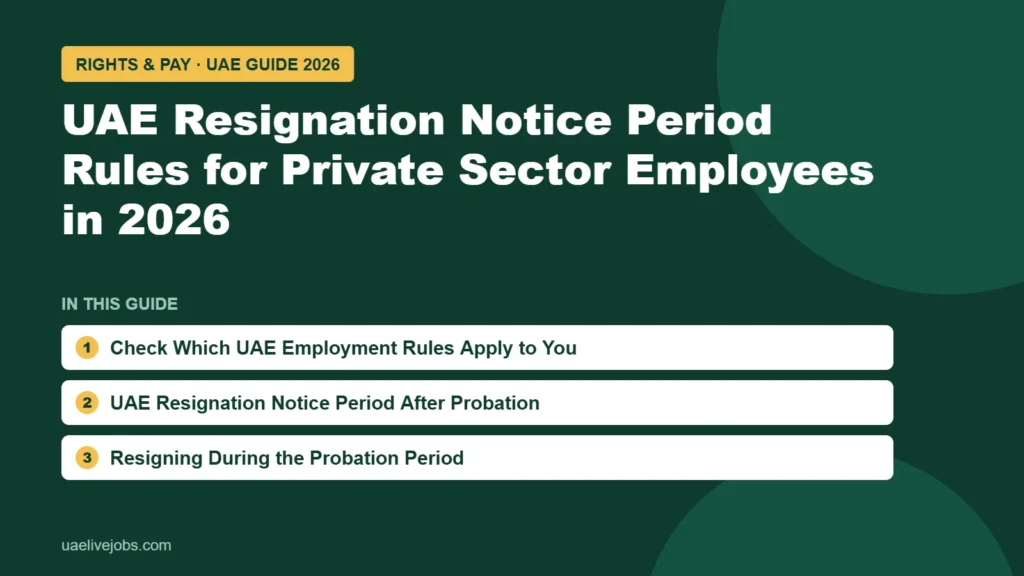
In the UAE, your resignation notice period is whatever your contract says, and for mainland private-sector employees that must be between 30 and 90 days. Different rules apply during probation and in DIFC and ADGM.
Check Which UAE Employment Rules Apply to You
This guide is for employees working in the UAE’s mainland private sector and other workplaces covered by UAE labour law and regulated by MOHRE, including employees with a work permit.
The main legal framework is Federal Decree-Law No. 33 of 2021 Regarding the Regulation of Employment Relationship. It came into force on 2 February 2022 and remains the key law for this type of employment contract in 2026. A fixed-term contract does not remove the applicable notice requirements. For the current law and amendments in 2026, read the MOHRE Labour Law text.
However, don’t rely on these UAE labour law rules without checking your employment contract and location, as MOHRE rules don’t automatically apply to every employment system. Different laws may apply if you work for:
- A federal or local government entity.
- A domestic worker employer.
- A company registered in DIFC.
- An employer based in ADGM.
- The armed forces, police, or security services.
For example, the mainland notice period may differ from the notice period under DIFC and ADGM rules. DIFC Employment Law No. 2 of 2019 has its own notice rules, while ADGM follows separate Employment Regulations 2019.
UAE Resignation Notice Period After Probation
After you complete probation, your UAE resignation notice period must be stated in the employment contract. Article 43 of UAE labour law sets this period at no less than 30 days or more than 90 days.
A 30-day notice period is common, but many management, sales, technical, and senior roles have 60 or 90 days. Don’t rely on what a colleague had. Check your signed employment contract.
| Contract Term | What It Usually Means |
|---|---|
| 30 days | The legal minimum after probation |
| 60 days | Common for experienced or specialist roles |
| 90 days | The legal maximum under mainland private-sector law |
The contractual notice period often reflects the employee’s role and seniority.
The employment relationship continues during this time. You remain employed, receive your agreed pay, and should complete reasonable work and handover duties.
Read the Notice Clause Before Resigning
Find the clause titled “termination,” “notice period,” or “resignation.” It should state your notice period and explain how you must give notice. Check whether it refers to calendar days or working days. Most UAE contracts use calendar days, but the exact wording matters.
Also check whether your employer has a resignation policy. It may require notice through HR software, a company email address, or a signed letter. A policy can’t reduce your legal rights, but ignoring its process can create avoidable arguments about when notice started.
The UAE Government’s guidance on terminating employment contracts confirms that either party can end a contract for a legitimate reason with notice in writing.
Written Notice Protects Both Sides
Send written notice of your resignation, even if you’ve already discussed it with your manager. An email is normally practical evidence when it clearly states your decision, last working date, and required notice.
Use your work email where possible. Send it to your manager and HR, then save a copy outside your company inbox if company policy allows. Keep proof of delivery and ask for an acknowledgement.
Your notice period usually starts when the employer receives your resignation, but the contract or company process may specify another trigger.
Resigning During the Probation Period
The probation period is different. Under Article 9, it can’t exceed six months, and shorter rules apply. Check your employment contract to confirm the terms that apply to you.
If your employer ends your contract during probation, it must give at least 14 days’ notice. If you want to resign, the required notice period depends on what you plan to do next.
Leaving the UAE During Probation
If you’re resigning during probation because you plan to leave the UAE, give your employer at least 14 days’ written notice.
This notice period applies even if the job isn’t suitable. Don’t disappear or stop attending work. Send the notice, keep proof, and ask HR about your work permit and residence visa steps. Cancellation or transfer depends on your employer and immigration process, so check the latest official MOHRE guidance for your circumstances.
Moving to Another UAE Employer
If you’re leaving during probation to join another employer inside the UAE, give one month’s written notice.
The notice period is one month. The new employer may need to provide compensation to the former employer for recruitment costs, unless the parties agree otherwise. This is mainly an employer-to-employer arrangement, not an automatic personal liability for you.
Still, be open with your new company about your probation status and intended joining date. Don’t promise a new employer that you can start next week when your legal notice period is one month.
When You Can Resign Without Notice
Immediate resignation is possible only in limited, evidence-based situations. It is not a shortcut for employees who found a better offer or dislike a manager.
Under UAE labour law, article 45 may allow a worker to leave without serving the normal notice period. Any end-of-service entitlement depends on meeting the statutory conditions and proving the relevant facts. If you leave under article 45 after a year or more of service, our gratuity calculator gives a rough figure for what you are owed.
Unpaid Wages, Harassment, and Serious Breaches
For unpaid wages, don’t resign in anger without records. Keep your contract, bank statements, payslips, attendance records, emails, and WhatsApp messages.
A written notice to the employer can create a clear record, but it doesn’t replace a required statutory report.
For harassment, assault, or violence, put safety first. Report the matter to the police where needed, and preserve written evidence, medical records, witness details, and relevant messages.
To rely on article 45, a worker must follow the reporting route and statutory conditions, not simply skip the notice period. An employer breach generally requires notifying MOHRE 14 working days before leaving, then remaining unresolved after the Ministry’s notification. Assault, violence, or harassment generally requires notification within five working days of being able to report; serious danger and fundamentally different work have additional conditions.
Employer Dismissal Without Notice Is Also Limited
An employer’s termination without notice is separate from the employee’s limited right to leave without notice.
Under article 44, an employer may dismiss a worker without notice only after a written investigation and a justified written decision. Grounds can include fraud or forged documents, serious misconduct, disclosure of confidential information, assault, working under the influence, misuse of position, or absence beyond the legal threshold.
The grounds in article 44 must be applied according to the current statutory wording and procedure. They can’t be used to re-label an ordinary resignation dispute as misconduct.
If you are accused of misconduct, ask for the allegation in writing and keep copies of every document you receive. If the dispute continues, consider filing a labour complaint and getting professional legal advice before leaving. This is general information, not personalised legal advice.
Notice Period Pay, Leave, and Handover Duties
Sometimes an employer asks an employee to leave immediately. This may be garden leave, where you stop working but remain employed. An employer-directed garden leave arrangement should specify your status and duties. Sometimes an employee wants an earlier exit. Both can affect your notice period, but get the agreement in writing.
Payment in lieu of notice is statutory compensation for all or part of the unserved notice period. Under the Labour Law, the party that fails to give or serve the required notice period may owe the worker wages for the full unserved period. During garden leave, wages and benefits generally continue under the agreed terms, although you may not perform daily work. Confirm any garden leave arrangement, dates, duties, and pay status in writing.
Agree an Early Exit Before Booking Travel
For example, if your contract requires a 60-day notice period and your employer agrees to release you after 30 days, treat the early release as a mutual agreement. Payment in lieu of notice may be due for the remaining 30 days if they aren’t waived. Ask for written confirmation that those days are waived before booking travel, because payment in lieu of notice could otherwise be claimed.
Don’t assume annual leave automatically shortens your notice period. Annual leave still needs approval unless there’s a written agreement on how it will be treated. Sick leave requires the applicable medical documentation and doesn’t automatically change the contractual notice period. Keep HR informed about sick leave dates.
Where the employer has terminated the contract, the worker is entitled to one unpaid day each week during the required notice to search for another job, subject to advance notice to the employer.
Complete a Clean Handover
A clean transition protects you. Keep a dated list of tasks completed during your notice period, including active tasks, client contacts, passwords held through approved systems, pending payments, files, equipment, and company property.
Return your laptop, access card, SIM card, vehicle, documents, and any company funds with a receipt. A missing asset can delay the final settlement and offboarding.
A non-compete clause doesn’t automatically stop you from resigning. Read the notice, leave, and non-compete terms in your employment contract before accepting a competing role. These clauses must be limited by time, place, and type of work, and they can be disputed if they’re too broad.
Final Settlement, Leave Pay, and Gratuity
Your final settlement should not be left open-ended. The employer must pay outstanding wages, other entitlements, and gratuity within 14 days from the contract termination date, according to the UAE Government’s private-sector end-of-service guidance.
Before your last day, ask HR for a written final settlement calculation. Compare it with your employment contract and salary records. Ask HR to explain any figures that don’t match your records.
What Your Final Settlement May Include
Your final payment may include:
- Salary through your final working day.
- Any unpaid commission or contractual allowance.
- Payment for accrued, unused leave.
- End of service gratuity, if you qualify.
- Deductions supported by law or a valid written basis.
For eligible full-time employees who complete at least one year of continuous service, EOSB may apply under the relevant private-sector regime. Eligibility can vary by employment category and applicable scheme. EOSB is generally calculated on basic salary, not the total salary package, under the standard system.
Where the employee qualifies under the applicable private-sector regime, the standard EOSB formula is 21 days’ basic wage for each year of the first five years, then 30 days’ basic wage for every year after that. Part-years are usually calculated proportionately.
The total gratuity cannot exceed two years’ basic wage. Employees who leave during probation generally don’t qualify under the standard gratuity rules. Confirm whether a special category or alternative scheme applies.
Check your unused annual leave separately. Payment is also generally based on basic wage. Ask HR to verify the EOSB figure and explain any difference in the calculation.
How to Submit a Resignation Email
Keep your resignation short, polite, and clear. You don’t need to explain every problem in the email. If there’s a serious dispute, seek advice before writing detailed allegations.
Include your full name, job title, resignation date, contractual notice period, and proposed final working date. The email provides written notice of your formal resignation, so keep it and the delivery record.
A Simple Resignation Email Example
Subject: Resignation Notice
Dear [Manager’s Name],
Please accept this email as my formal resignation from my position as [Job Title]. Under my employment contract, I will serve a [30/60/90]-day notice period. My expected final working day is [Date].
I will complete my pending work and support a proper handover during this time. Please confirm receipt of this resignation and advise me about the offboarding process.
Kind regards,
[Your Name]
If you’re joining another employer, make sure your joining date falls after your notice period ends.
Ask HR for the offboarding and immigration checklist, including visa cancellation, work permit cancellation, company property, and a relieving letter.
If HR says your final dues will be delayed, refuses to acknowledge your resignation, or you can’t serve the full contractual period, keep the email trail. Ask whether payment in lieu of notice applies and how any compensation will be calculated.
You can raise a labour complaint through MOHRE if the issue can’t be resolved directly. Unresolved matters may ultimately proceed through the appropriate formal dispute route, including the labour court where applicable.
For a dispute involving unpaid salary, dismissal, or gratuity, check your final settlement, including leave pay and EOSB, before signing any settlement document. Verify the latest official guidance or obtain advice from a qualified UAE labour professional.
Notice period in UAE labour law: probation, leave and immediate exits
Is the UAE resignation notice period always 30 days?
No. After probation, the notice period stated in your contract must generally be between 30 and 90 days. Many employees have 30 days, while specialist and senior roles may have 60 or 90 days.
What notice must I give during probation?
If you are leaving the UAE, you generally need to give at least 14 days’ written notice. If you are moving to another UAE employer, the required notice is generally one month.
Can I resign immediately without serving notice?
Only in limited, evidence-based situations allowed under UAE labour law, such as certain serious employer breaches. You may need to notify MOHRE and follow specific statutory procedures before leaving without notice.
Can annual leave shorten my resignation notice period?
Annual leave does not automatically reduce the contractual notice period. It normally requires employer approval or a written agreement explaining how the leave will be treated.
When should I receive my final settlement?
The employer should pay outstanding wages, eligible leave pay, gratuity, and other final entitlements within 14 days from the contract termination date. Before your last day, ask HR for a written calculation and check it against your salary and employment records.