
A smaller salary credit can cause immediate stress when rent, transport, and family costs are due. Under the UAE salary deduction rules, an employer cannot reduce your monthly wage for any reason it chooses.
For many mainland private-sector employees, Federal Decree-Law No. 33 of 2021 is the starting point. It may not apply to DIFC, ADGM, government, domestic-worker, or other separately regulated employment systems. Your employment contract, payslip, bank credit, and any written approval all matter when checking whether a deduction is lawful.
The key is to separate a genuine legal deduction from unpaid leave, sick leave, a payroll error, or a cost the employer should cover.
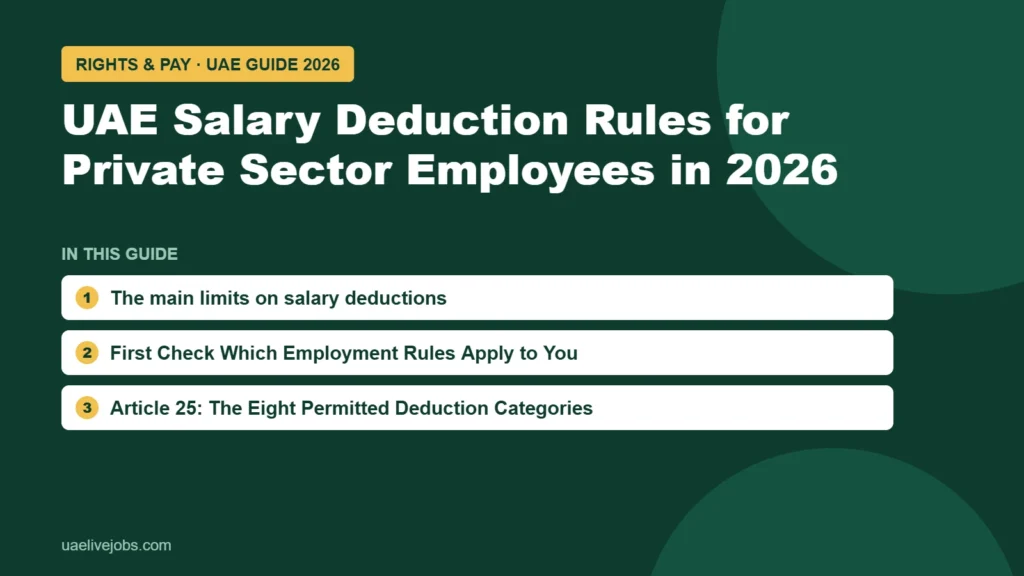
The main limits on salary deductions
- Article 25 of the UAE Labour Law lists when an employer may deduct from a worker’s wage. If the reason isn’t listed, ask for a written explanation before accepting it.
- The maximum deduction limit is generally 50% of the wage in one month.
- Overpayment recovery cannot exceed 20% of the wage in a month. This limit applies to salary overpayments, not automatically to loan repayments.
- Loan repayments require the employee’s written consent and must not carry interest. Keep the agreement and written records as evidence.
- Disciplinary salary deductions have separate limits and procedures. A verbal fine isn’t enough.
- Visa, work-permit, and recruitment charges aren’t listed as permitted salary deductions under Article 25.
- Paid annual leave salary differs from final unused-leave pay. The final payment uses basic salary, while unpaid leave and sick leave follow separate pay rules.
- Keep your contract, payslips, bank statements, and messages. These records matter if you need to raise the issue with the Ministry of Human Resources and Emiratisation, known as MOHRE.
A Wage Protection System (WPS) bank transfer proves that money was sent. It doesn’t, by itself, prove that the salary amount and deductions were correct.
First Check Which Employment Rules Apply to You
The UAE Labour Law generally applies to eligible mainland private-sector employees whose employer is regulated by MOHRE. Its federal legal source is Federal Decree-Law No. 33 of 2021.
This includes many jobs in Dubai, Abu Dhabi, Sharjah, Ajman, Ras Al Khaimah, Fujairah, and Umm Al Quwain.
Your office location alone does not decide the legal route. For UAE employers, check the legal employer named in your employment contract, not only the workplace brand.
Mainland Jobs, Free Zones, and Other Employment Systems
DIFC and ADGM employers have their own employment laws and dispute processes. Some free-zone employees, domestic workers, and government employees may also follow different rules, including on sick leave.
If your salary issue involves a free-zone company, first confirm the authority that regulates that employer. Filing with the wrong authority can slow down an already stressful pay dispute.
Your Contract Is Still Important
The law sets minimum protections, but your contract explains your basic salary, allowances, pay date, and agreed benefits. A deduction from a housing allowance may still be a wage issue if that allowance is part of your contractual monthly pay.
Before accepting a job, check the salary breakdown carefully. This UAE contract checklist can help you compare the offer letter with the contract you are asked to sign.
Article 25: The Eight Permitted Deduction Categories
The permitted reasons are set out in Article 25 of Federal Decree-Law No. 33 of 2021. This limited list forms part of the UAE Labour Law. It doesn’t give payroll a general right to take money whenever there is a workplace issue.
Loans, Overpayments, and Statutory Contributions
An employer may deduct:
- Loan repayments for a loan the employer gave you, provided it carries no interest and stays within the legal limit.
- Salary overpayment recovery, within the monthly limit set by law.
- Amounts required by law, such as contributions to pension, retirement, or insurance schemes.
- Contributions to an approved savings fund or similar approved arrangement.
A common situation is a payroll overpayment. For example, if AED 2,000 was mistakenly added to your salary, the employer may recover it. Payroll should show the original error, the amount recovered each month, and the remaining balance.
Approved Services, Discipline, Court Orders, and Damage
The remaining categories cover:
- Contributions to employer social projects or services approved by MOHRE, where you provide written consent.
- Deductions imposed as disciplinary penalties under an approved disciplinary regulation.
- Court-ordered deductions for debts established by a judgment.
- Damage compensation for proven loss caused by the employee, within the legal monthly limit.
Each category needs a clear legal basis, evidence, and the applicable procedure. A manager can’t label a deduction “company loss” or “poor performance” and assume that makes it lawful. A written consent requirement applies only where the relevant category requires it, and good payroll records don’t replace that consent. For discipline, the employer must follow the applicable process. For damage, there should be evidence of what happened, the cost, and why the employee is responsible.
Maximum Deduction Limits You Should Know
The key maximum deduction limit is generally 50% of the wage in one month. This is a ceiling, not a standard payroll amount. Individual deduction categories may have lower limits.
A payslip may show gross salary before deductions and net salary after deductions. However, statutory limits apply to the legally relevant wage under the UAE Labour Law, not automatically to whichever figure is labelled gross or net. Basic salary may matter for separate entitlements or final-settlement calculations, but it should not replace the legal wage basis for Article 25 limits.
| Deduction Type | Main Limit or Condition |
|---|---|
| All deductions combined | Generally no more than 50% of the wage per month |
| Loan repayments | Generally no more than 10% of the wage, with no interest and appropriate written consent |
| Overpayment recovery | No more than 20% of the wage per month |
| Court-ordered deductions | Generally no more than 25% of the wage, except alimony where the law allows otherwise |
| Damage compensation | No more than five days’ wages per month, after the required investigation and evidence |
| Disciplinary penalties | Must follow Article 39 and the applicable disciplinary rules, including the statutory wage-deduction limits |
The 50% ceiling doesn’t mean an employer should automatically take half your salary. It is a maximum, not a normal payroll practice.
The 20% Rule Applies to Overpayment Recovery
The 20% limit applies to recovering salary overpayments, not to every kind of employer loan.
If you receive an advance or loan from your employer, check the written agreement before signing. It should state the amount and repayment schedule. Loan repayments should not include interest, and any required employee approval should be documented.
For example, if your monthly wage is AED 5,000 and payroll overpaid AED 1,500, the maximum overpayment recovery in one month is AED 1,000. The remaining AED 500 should carry forward.
Court Debts, Alimony, and Disciplinary Fines
A court order can require a salary deduction, but court-ordered deductions are generally capped at 25% of the wage. Alimony is an exception where the law permits a higher amount.
Disciplinary penalties need extra care. Article 39 treats a wage deduction as a disciplinary sanction and limits it to five days’ wages in a month, subject to the applicable procedures and executive regulations. This rule is separate from the general Article 25 deduction categories. Employers should not treat financial penalties or a separate percentage as interchangeable with the five-day limit. Review the official MOHRE Labour Law text if an employer relies on a disciplinary rule.
Costs and Payroll Changes That Need Careful Checking
Not every reduction in a payslip is a legal deduction. Some are payroll adjustments. Others may be unpaid absence. Some may be an employer trying to shift its own costs to staff.
Visa, Recruitment, and Work-Permit Charges
Article 25 does not provide a general basis for charging employees for visa processing fees, work permits, medical costs, recruitment expenses, or agency fees. Other UAE rules may also govern which employment costs an employer must cover.
If a company deducts AED 500 every month to recover your employment visa cost, ask for the legal basis in writing. A clause in an offer letter does not automatically make the charge enforceable.
The same caution applies when a recruiter asks you to pay for a job, visa, or medical test through a personal account. These demands are a warning sign, especially before you have a verified contract.
Unpaid Leave Is Not the Same as a Fine
Unpaid leave can reduce a month’s pay because you did not work during that period. Approved sick leave is different and may be subject to a separate statutory pay rule.
It should not appear as a disciplinary punishment or disguised disciplinary penalties unless the employer followed the correct process. Ask payroll for the dates counted as unpaid, the daily-rate calculation, and the attendance record used.
If the absence was approved annual leave, that is different. Your annual leave salary should not be treated as a reason for a salary cut. Check the approved sick leave record and the applicable current statutory pay rule.
Annual Leave Pay and Final Leave Payouts
Annual leave questions often become confusing when an employee resigns or receives a final settlement. The wage basis changes depending on the situation.
Pay During Approved Annual Leave
Under the UAE Labour Law framework, your annual leave salary is based on the wage applicable when you become entitled to that leave. The calculation may include agreed wage components, subject to the applicable rules and employment terms, rather than only basic salary.
Sick leave is a separate statutory leave category from annual leave. If you take five approved annual leave days and see a salary reduction, ask HR to correct it or explain the calculation. Check the approval email or leave-system record before assuming the leave was entered correctly.
Unused Leave at Termination
Payment for unused annual leave at the end of employment is calculated using basic salary, not the full wage package. That difference can make the final figure lower than your normal monthly take-home pay.
The Executive Regulations on annual leave support this distinction. Sick leave shouldn’t be recoded as unpaid leave without checking the applicable rule. Review your final settlement line by line, including outstanding salary, leave balance, deductions, basic salary, and any end-of-service gratuity. The gratuity is a separate settlement item with its own calculation basis, not a substitute for unused annual-leave pay. To check the gratuity line on your settlement, put your basic salary and dates into our gratuity calculator and compare the figure.
What Good Payroll Records Should Show
Clear records prevent many salary arguments. Good payroll management also helps you spot an improper deduction before several months pass.
Check Four Documents Together
Compare these records for every month where the salary changes:
- Your signed employment contract, any salary amendment, and the basic salary figure used in calculations.
- The payslip or payroll breakdown.
- Your bank statement showing the actual salary credit.
- Written messages or approvals about loans, leave, sick leave, damage, repayment plans, and relevant attendance records.
For employees covered by the Wage Protection System (WPS), the transfer record can help prove when payment was processed and how much was transferred. It doesn’t by itself prove that every deduction was lawful. Read the UAE Wage Protection System guide if you need to understand what WPS records can and cannot prove.
Ask for a Written Breakdown Early
Don’t wait until your visa is cancelled or HR access is removed. Send a short written request identifying the pay month, deducted amount, and reason for clarification.
A useful request can say: “Please provide the payslip and written basis for the AED 750 deduction from my August 2026 salary, including the relevant approval or calculation from the payroll system.” Keep the reply, even if payroll later corrects the amount. If payroll doesn’t respond, the record can support a documented MOHRE complaint.
How to Raise an Unlawful Deduction With MOHRE
Start calmly, but keep the matter in writing. Many payroll errors are fixed once the employer sees a clear calculation. If there is no proper response, the Ministry of Human Resources and Emiratisation, or MOHRE, provides a formal route for eligible private-sector employees.
Build a Simple Evidence File
Save copies of your contract, Emirates ID, work permit details if available, payslips, bank statements, WPS records, emails, and WhatsApp messages with HR. Keep any relevant sick leave documents if the deduction involves an absence or leave record.
Make a one-page calculation showing:
- Your agreed monthly wage.
- The amount you expected.
- The amount received.
- Each deduction shown on the payslip.
- The missing amount and the month involved.
These records may help support a suspected breach involving labour law violations. They can also help clarify whether the deduction resulted from a payroll error or an authorised adjustment.
Do not sign a document confirming that you received all dues if the amount has not reached your account or you don’t understand the document.
Submit Through the Correct Channel
MOHRE provides a private-sector labour complaint service through its official channels. You can submit a MOHRE complaint or call the Labour Claims and Advisory Center on 80084. You can also use the MOHRE contact details for general support at 600590000.
The process can involve notifying both parties and trying to settle the issue before further referral. Any financial penalties or other employer consequences depend on the facts and the applicable legal provision. A complaint does not guarantee a result, but it creates an official route to present your records.
If you work in the DIFC, ADGM, or another special employment system, a different authority or complaint process may apply.
For documents and practical steps, see how to file a MOHRE salary complaint.
FAQ: Salary Deductions for UAE Employees
Can my employer deduct a performance fine?
Not without a lawful disciplinary basis and the required process. Disciplinary penalties must follow the applicable workplace rules. A poor performance label alone doesn’t give an employer unlimited power to deduct salary.
Can my employer deduct money for a broken item?
Damage compensation may be possible where the employee caused the loss. After checking the applicable rules, the deduction is generally limited to five days’ wages per month. Ask for the incident record, evidence of the loss, and the calculation.
Can my employer deduct loan repayments from my salary?
Loan repayments should be supported by a clear employee agreement or other reliable documentation. The deduction must also comply with the applicable limits. Don’t assume the 20% overpayment rule applies to every loan arrangement.
Can my employer make court-ordered deductions?
Court-ordered deductions may be made when supported by the relevant court or official documentation. The 25% limit commonly associated with court debts isn’t universal, so check whether an official exception applies to your case.
What should I do about an unlawful deduction?
Keep your payslips, contract, written notices, and other relevant records. If the issue isn’t corrected, submit a MOHRE complaint through the correct authority and provide evidence supporting your position.
Are illegal salary deductions punished?
Employment breaches can lead to action and penalties under UAE law, depending on the facts and applicable provisions. There is no safe fixed fine to assume for every deduction case. Employers should correct errors quickly, while employees should document the issue and use the proper complaint route.