
You get a job offer in Dubai, then the recruiter asks you to pay before they release the contract. Should you send the money? Pause before paying. UAE recruitment fees for private-sector employment are the employer’s responsibility, not a bill for the person seeking work.
The same concern applies if the request comes from an employer or appears under another name, such as a visa deposit. Knowing which costs belong to the hiring process helps you check the offer and decide what to do next.
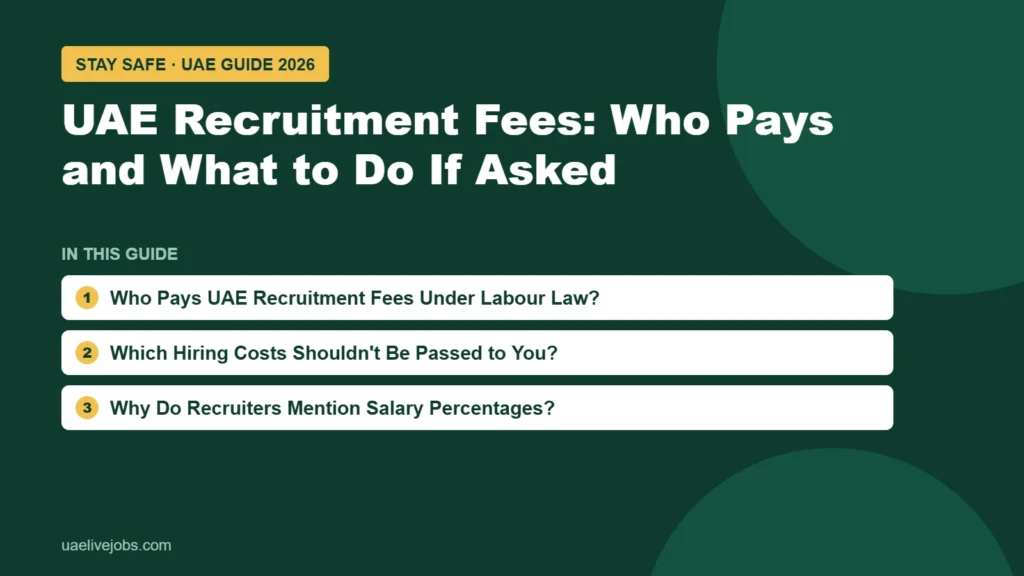
Who Pays UAE Recruitment Fees Under Labour Law?
The Employer Cannot Charge the Worker
For employment covered by the federal private-sector labour law, Article 6(4) of Federal Decree-Law No. 33 of 2021 prohibits an employer from charging a worker recruitment and employment costs. The prohibition covers both direct charges and indirect collection. This includes the cost of Tawjeeh training and contract processing.
That matters after you start work, too. An employer cannot make an unlawful hiring charge acceptable by calling it an advance or recovering it from your wages over several months. If you see such a deduction, ask for its reason in writing and check the UAE rules on salary deductions.
Agencies Cannot Sell You Access to a Job
The UAE government’s worker-rights guidance says workers shouldn’t be charged recruitment agency fees or candidate placement fees for registration, interviews or job placement.
An agency may have an agreement with the employer and charge that employer for hiring services. You shouldn’t have to fund that arrangement. The rule doesn’t change because the agency calls its request a CV activation fee, file-opening charge or refundable deposit.
A promised refund after your first salary does not make an upfront recruitment charge safe.
Which Hiring Costs Shouldn’t Be Passed to You?
Work Permits, Entry and Residency Processing
A genuine hiring process can involve government applications and medical tests. A real fee in that process doesn’t automatically mean the employer can transfer its recruitment and employment costs to you.
MOHRE’s worker guidance identifies specific recruitment and migration costs as employer-paid, including accredited recruitment-agency fees, travel to the UAE for recruitment, entry visas, post-arrival medical tests and residence-permit issuance. This guidance doesn’t make every fee connected with a visa, medical test or personal job search the employer’s responsibility. If someone says you must pay work permit fees to release a permit or complete the employer’s visa process, ask for the exact requirement and check it with the responsible authority.
Be careful with payment instructions. A request to transfer money to a recruiter’s personal account isn’t an official payment route, even if the message includes a company logo or a picture of an application form.
Personal Job-Search Expenses Are Different
You may choose to pay for your own travel to attend interviews, a job exploration visa or documents you obtain for personal use. Those expenses aren’t automatically an employer’s recruitment bill. Equally, paying for your own trip doesn’t mean you must pay an employer’s work-permit costs once hired.
Keep the purpose of each payment clear. Who requested it? Which application is it for? Who is the official payee? If you’re considering travel to look for work, check the UAE job seeker visa requirements and costs separately from any promised employment offer. A job seeker visa doesn’t itself authorize you to work.
Why Do Recruiters Mention Salary Percentages?
You may see UAE recruitment fees described through recruitment agency pricing based on a percentage of annual salary. That annual salary percentage refers to what an agency might quote an employer, not what it can demand from you.
Private estimates vary. One UAE recruitment-methods estimate gives a range of 12% to 18% of first-year salary for certain permanent placements. That is a market estimate, not a government tariff or a charge for candidates. There is no verified UAE-wide median fee that tells every employer what it must pay.
An employer might agree to pay permanent placement fees after a successful placement, use a contingency recruitment model, or negotiate a retained search agreement for a hard-to-fill role. These commercial terms belong in the employer’s agreement with the recruiter. If a recruiter tells you, “Our agency charges 15%, so you must pay part of it,” the employer’s pricing decision doesn’t change your rights.
Warning Signs Beyond the Word “Fee”
Watch for Renamed Payment Requests
A placement demand may arrive as an application charge, paid training, a security deposit or a fee to activate your offer. Some messages say payment is urgent because a visa quota or interview slot will disappear. Don’t let a short deadline stop you checking the claim.
Other signs deserve attention: an unusually high salary with vague duties, an offer after a brief chat, or a contact who won’t name the employer. A WhatsApp message alone doesn’t prove fraud. Legitimate hiring teams use messaging apps, but an unexpected offer paired with a payment request needs independent checking. These patterns also appear in common UAE job scams and how to avoid them.
Protect Your Documents as Well as Your Money
Some fake recruiters ask for passport scans, Emirates ID images or bank details before explaining the job. A real employer may need documents later, but you can verify who is asking before sending them. Never share passwords or one-time passcodes for a job application.
Check the sender’s email address against the employer’s actual website. A copied logo, a familiar company name or a polished offer letter is not enough. If the person refuses a proper conversation or insists you use an unfamiliar payment link, stop the process until you can confirm the details yourself.
How to Check a UAE Offer Before You Commit
Start with the employer named in the offer. Find its official website and contact number independently, then ask whether the vacancy and recruiter are genuine. Don’t rely only on a number supplied in the suspicious message. Compare the job title, salary and workplace with what the employer confirms.
For eligible mainland private-sector offers, ask for the details needed to check the offer through MOHRE’s official services. An offer letter, an approved employment contract, a work permit and a residence visa are connected, but they are not interchangeable. Our guide shows how to check your UAE employment offer before you resign or travel.
If an agency is involved, ask for its registered business name, licensing authority and licence details. Check those details through the relevant official channel. A genuine company can still be impersonated, so confirm that the person contacting you works with the agency and that the agency handles the vacancy. You can also verify a UAE recruitment agency licence before sharing more information.
What to Do If Someone Asks You to Pay
Before You Have Paid
Don’t send money while you check the request. Ask the employer or recruiter to explain in writing what the charge covers, who receives it and why you are expected to pay. Keep the offer, messages, account details and payment instructions.
You can reply plainly: “Please confirm the official basis for this payment and provide the employer’s details so I can verify the offer.” You don’t need to argue with someone pressuring you to pay within hours. Avoid opening unfamiliar payment links or uploading documents to a site you haven’t checked.
For a private-sector employment question within its remit, contact the Ministry of Human Resources and Emiratisation (MOHRE). Its official service information lists 600590000 as the call-centre number. Use contact details you find on the official site, not a number sent by the recruiter.
If You Already Paid or Shared Documents
Save receipts, transfer records, screenshots, the job advertisement and every message. Contact your bank or payment provider promptly if you transferred money, and ask what options are available. Report suspected fraud to the relevant police channel and raise the recruitment-cost issue with MOHRE where it has authority.
If you’ve sent passport or ID images, stop sending further documents. Tell the relevant authorities what you shared, particularly if the person also obtained bank information or account access. Don’t pay a second “recovery” or “refund processing” fee to the same contact.
If the charge came from an employer after you started work, keep payslips and any written explanation of the deduction. Ask the responsible labour authority about your options before signing an acknowledgement that you owe the amount.
Does Your Work Situation Change Where You Seek Help?
Working in a Free Zone or Applying From Abroad
First, check which authority handles the employer and your permit. MOHRE is the starting point for many mainland private-sector matters, but some free-zone employees use their zone’s employment channels. DIFC and ADGM have separate employment rules and dispute routes. Confirm the right channel before filing a complaint.
If you’re applying from overseas, also check the recruiter under your home country’s rules. Ask which UAE employer will hire you and which local agency is involved. Verify those details before travelling. An overseas recruiter’s claim that a fee is “normal here” does not settle whether you can lawfully be charged for the UAE job.
Changing Employers During Probation
A job change can involve recruitment-cost arrangements between employers. That is different from a demand that you personally reimburse an agency or your first employer. Read the UAE probation rules when changing employers if a company asks you to pay because you’re leaving early.
Get any request in writing before responding. The reason given, your contract, the employers involved and the authority covering your job all matter.
What can a recruitment agency in Dubai legally charge?
Can a Dubai Recruitment Agency Charge Me to Register My CV?
The UAE government’s worker-rights guidance says prospective employees cannot be charged recruitment fees. You should not pay an agency to register your CV, arrange an interview or secure placement. If it requests a differently named payment, ask what it covers and check with the relevant authority.
Do I Have to Pay My Employer Back for a Work Visa?
Federal private-sector law prohibits employers from collecting recruitment and employment costs from workers, directly or indirectly. A promise to repay those costs through salary deductions deserves scrutiny. Keep the agreement and payslips, then ask MOHRE or the authority responsible for your employment for guidance.
Is Every Request for a Medical or Document Fee a Scam?
No. Medical tests and documents can be part of a genuine process. The question is who is responsible for that particular cost and where payment should go. Verify the application and official payment route before sending money, especially if the request comes from an unfamiliar recruiter.
What If the Recruiter Says I Must Pay Today?
Don’t let the deadline replace verification. Keep the message, check the employer and agency independently, and contact the relevant official authority if you cannot confirm the charge. Losing an unverified offer is better than transferring money or sensitive documents under pressure.