
You’ve found an evening job, weekend shift, remote work opportunity, or second role to help with your UAE expenses. A verbal agreement isn’t enough. Starting work before your paperwork is approved can put both you and the hiring company at risk.
In 2026, a UAE part-time work permit is the legal route for most residents who want to work for a second UAE employer while keeping their current job. It is not the same as a freelance licence. Remote work for a UAE business still counts as employment and may require the appropriate approval.
Start by checking whether your legal status, role, visa, and proposed employer fit the permit rules.
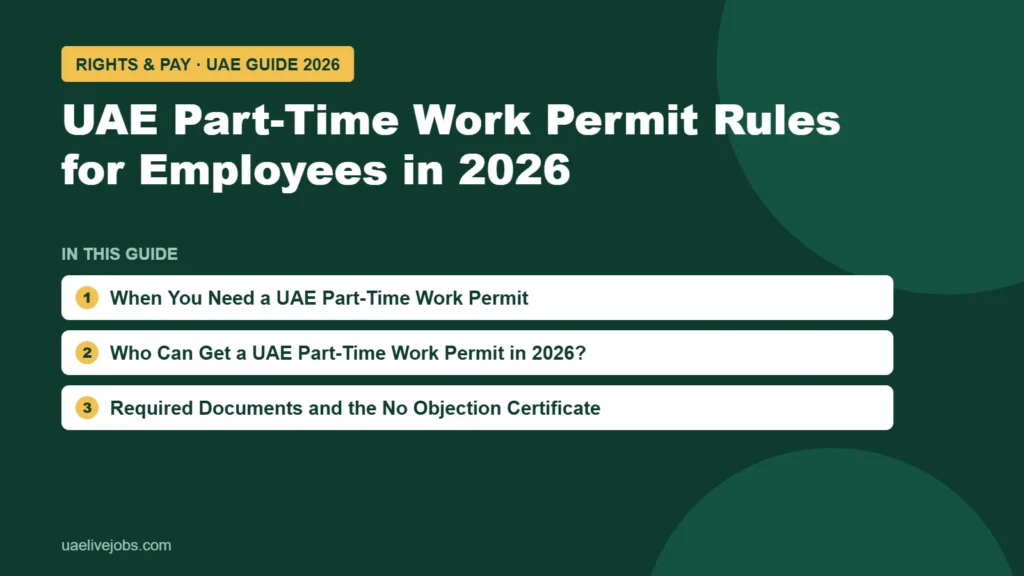
When You Need a UAE Part-Time Work Permit
A full-time UAE job does not automatically let you work evenings or weekends for another business. If a second company will employ you, it must obtain the correct approval before you start.
A Second Job Is Legal, But Approval Comes First
UAE Labour Law allows eligible workers to work for more than one employer. The official UAE work permit guidance confirms that a worker may work for multiple employers after obtaining a part-time permit.
Part-time employment means your hours or working days are less than those of a full-time employee in the same organisation. It can suit retail staff, tutors, hospitality workers, customer service employees, skilled professionals, and remote work roles.
A second job becomes a problem when it starts before the permit is issued. Remote work for a second UAE company is not exempt from this requirement. Informal help is different from an employment relationship, and a manager’s email does not replace official approval. Even one paid trial shift can count as unauthorised work.
The Secondary Employer Must Apply
The company offering the second job normally starts the application. It must be a properly registered establishment, and its authorised signatory submits the request through MOHRE channels or an approved service centre.
The employee supplies personal documents and signs the job offer or work agreement. The hiring company supplies its records, pays the government charges, and follows up on the request.
Your full-time employer also remains relevant. Don’t accept working hours that clash with your main agreement, affect your attendance, or create a conflict with confidential work.
Who Can Get a UAE Part-Time Work Permit in 2026?
The permit is designed for UAE residents who want a lawful second employment relationship. Your visa status and employer type matter before anything else.
Your Age and Residence Status Come First
MOHRE’s published conditions state that workers must be at least 18 years old. You also need valid UAE residence status and a passport. A visitor or tourist visa doesn’t give you the right to take paid work.
Employees sponsored by a mainland private-sector employer can usually apply through this route if they meet the conditions. Residents under family sponsorship may also qualify, but sponsor approval and the correct MOHRE process may apply. A resident doing remote work for another company still needs the correct employment route.
The safest rule is simple: don’t assume a residence visa lets you work for any company. It allows you to live in the UAE, while a permit authorises employment. Family sponsorship alone doesn’t authorise employment.
The Job and Employer Must Also Qualify
The secondary employer must be licensed and registered with the relevant labour authority. For MOHRE applications, this usually means a mainland private-sector establishment covered by the Ministry.
Some jobs require proof of qualifications. A school role, healthcare position, engineering job, or other regulated profession may require attestation of educational certificates or a professional licence. The hiring company should check this before offering you a start date.
Your two roles should make practical sense. A remote work location doesn’t by itself remove employer, job-category, or authority requirements. For example, a receptionist can work an approved weekend retail shift. They shouldn’t take a second position that breaches a non-compete clause, exposes trade secrets, or prevents them from performing their main job safely.
Required Documents and the No Objection Certificate
Missing paperwork is one of the main reasons applications stall. Gather your documents early, then send clear copies to the secondary employer.
Documents MOHRE May Request
A typical UAE part-time work permit application submitted through the MOHRE part-time work permit process includes:
- A passport copy with at least six months’ validity and a valid UAE residence visa.
- A recent personal photo with a white background.
- Emirates ID details, where requested through the application process.
- A signed job offer or role agreement that identifies whether the arrangement involves remote work, onsite work, or a mix of both.
- Educational certificates if the job category requires them.
- A No Objection Certificate, or NOC, from your current sponsor when the case requires it.
The new employer may also need to provide its trade licence, establishment card, and authorised signatory details. Those are company documents, so you should not be asked to arrange them yourself.
Use readable copies. Blurry passport scans, expired visa pages, and mismatched names can delay approval.
Do You Need an NOC From Your Main Employer?
Treat the NOC seriously. In many cases involving an employee already sponsored by another employer, the current sponsor’s no-objection letter is requested as part of the application. Family sponsorship cases may also require approval from the sponsor.
The exact document list can change based on your visa, job category, and employment record. Ask the secondary employer to confirm the live MOHRE checklist before you submit anything.
If your main employer refuses to give an NOC, there is no safe shortcut. Ask why it was refused, review your agreement, and discuss whether different schedules would address the concern. Never submit an altered letter or start working without approval.
An NOC can support an application, but only an approved permit makes the second job legal.
How the Application, Fees, and Validity Work
The process is employer-led, but employees should follow every stage. Don’t wait until your first shift to ask whether the permit has been approved.
The Usual Step-by-Step Application Process
Most applications follow this order:
- The secondary employer confirms that the role is part-time, checks whether it involves remote work, and prepares the job offer.
- You provide your passport, photo, qualifications where needed, and NOC if requested.
- The employer submits the request through MOHRE’s online channels or a TASHEEL service centre.
- Government fees are paid after the application reaches the required stage.
- Once approved, the employer completes the employment contract process and you can begin the second role.
You can review the current conditions on MOHRE part-time work permit. Keep a copy of the approved permit, offer letter, and contract. If remote work applies, reflect the arrangement in the offer, permit, or contract where applicable. These documents matter if your employer later changes your work location, duties, or schedule.
Permit Cost, Processing Time, and Renewal
The federal charges normally connected with the permit are shown below.
| Item | Current Amount or Period |
|---|---|
| Work permit application fee | AED 100 |
| Permit approval fee | AED 500 |
| Total federal fees | AED 600 |
| Standard permit validity | One year |
The secondary employer normally pays the application fee and other permit costs. A TASHEEL centre may charge a separate service fee, so ask for a payment receipt and confirm the full amount before paying.
A complete request may be decided within a few working days, but MOHRE does not give one guaranteed processing time for every case. Missing documents, an expired residence visa, or an employer record issue can hold it up.
A one-year validity period isn’t permanent. If you plan to continue the second role, ask the employer about renewal before it expires.
Working Hours, Annual Leave, and Employee Rights
A permit gives you legal approval for a second job. It does not remove your statutory entitlements or allow an employer to keep your work terms vague.
Put the Hours and Pay in Writing
The employment contract should state your workdays, hours, job title, work location, pay, and payment method. Official guidance describes part-time work as fewer than eight hours a day. For remote work, record the location, schedule, pay, and reporting expectations clearly.
Ask direct questions before signing, especially when remote work changes how payment or shifts are handled. Is your pay hourly, daily, or monthly? Will you be paid by bank transfer? Are transport, sales commission, or overtime included? Who will approve changes to your shift?
Don’t rely on WhatsApp messages for these terms. A signed contract is what protects you if wages are delayed or duties suddenly change.
Leave and Gratuity Are Calculated Proportionally
Part-time employees have employment rights, but some benefits are based on actual hours worked. Under the UAE Labour Law, annual leave for part-time employees is generally calculated in proportion to the hours worked, subject to the applicable minimum of five working days per year.
End-of-service gratuity can also apply after the required service period. For part-time arrangements, end-of-service gratuity is calculated on a pro-rata basis by comparing your contracted working hours with full-time hours. Our gratuity calculator works on full-time figures, so for part-time work scale the result by your contracted hours.
The UAE Labour Law text published by MOHRE is the reference point for these rights under the applicable Federal Decree-Law. Keep your contract, payslips, attendance records, annual leave records, and bank payment proof.
Each employer is responsible for its own contract. Your main employer’s benefits do not replace what the secondary employer owes under the part-time agreement.
Fines, Free Zones, and Other Cases to Check First
The biggest mistake is treating a side job as casual work. In the UAE, paid work needs the right legal permission.
Unauthorised Work Can Be Expensive
The UAE Government’s rules on working for two employers state that an expatriate working for another company without an official permit can result in an AED 50,000 fine for the hiring company.
The wider penalty provision in the UAE Labour Law can impose fines from AED 50,000 to AED 200,000 on an employer that hires a worker without permission. The main published fine targets the hiring company, while the employee may face separate work permit, visa, or employment consequences.
Don’t risk your visa status for cash-in-hand shifts, unpaid “training” days, or a recruiter who says paperwork can come later.
Free Zones, Freelance Work, and Temporary Roles Are Different
The MOHRE part-time work permit route mainly applies to eligible mainland private-sector employers, whether the role is onsite or involves remote work.
A job in DIFC, ADGM, JAFZA, Dubai South, RAKEZ, or another free zone, including remote work with a free-zone entity, may fall under that zone’s own employment authority.
The emirate alone does not decide the route. The employer’s trade licence, your visa, job category, and issuing authority help determine whether the MOHRE or free-zone route applies.
A freelance permit is also different from a UAE part-time work permit. Freelance work usually covers independent services under the terms of the issuing authority. Employee-based remote work is still employment, and freelance services do not automatically allow you to become an employee of any company that offers you work.
For a short assignment, an employer may need a different route, such as the MOHRE temporary work permit. Domestic workers and workers with unusual visa arrangements should get confirmation directly from MOHRE or the relevant authority before accepting another job.
Part-time work permit cost, validity and NOC rules
Can I work a second job in the UAE without a part-time work permit?
Usually, no. You must obtain the appropriate approval before starting paid work for another UAE employer, including remote work, because a verbal agreement or job offer does not replace an official permit.
Who applies for the UAE part-time work permit?
The secondary employer normally submits the application through MOHRE’s online channels or a TASHEEL service centre. You provide your personal documents, sign the job offer or contract, and provide an NOC from your current sponsor when the case requires it.
How much does a UAE part-time work permit cost and how long is it valid?
The listed federal fees are usually AED 100 for the application and AED 500 for approval, for a total of AED 600. The standard validity is one year, but a TASHEEL centre may charge a separate service fee and processing times can vary.
Do I need an NOC from my main employer?
An NOC may be requested when you are already sponsored by another employer, and family-sponsored residents may also need approval from their sponsor. Requirements depend on your visa, job category, and employment record, so ask the secondary employer to confirm the current MOHRE checklist.
Do free-zone jobs and freelance work use the same permit?
Not necessarily. Free-zone employment may be governed by the relevant free-zone authority, while freelance permits cover independent services and do not automatically authorise employee-based work for another company.