A UAE hiring manager can decide in seconds if your CV is worth opening. In 2026, that decision often happens twice, first by an ATS (applicant tracking system), then by a recruiter who wants quick proof you fit the role.That’s why UAE CV format looks a little different from what many candidates use elsewhere. Employers commonly expect practical details near the top, such as visa status, nationality, location, and availability. They also want a clean layout because ATS tools read plain text, not design.This guide gives you a copy-ready, ATS-friendly UAE CV template, the best section order for 2026 hiring, and clear rules you can follow line by line. If you’ve been applying with no replies, formatting may be one of the hidden reasons (along with other top reasons UAE job applications get rejected).
UAE CV format rules for 2026 ATS screening
ATS-friendly doesn’t mean boring, it means readable by software and clear for humans. Most ATS platforms struggle with decorative layouts, unusual symbols, and “creative” section styling. A UAE-ready CV in 2026 should feel simple, direct, and consistent.Start with a reverse-chronological layout for work experience (latest role first). That’s still the default expectation in the UAE for most industries, from hospitality to finance to engineering.Keep formatting plain:
Use a single-column page.
Use standard headings like “Professional Summary,” “Work Experience,” and “Education.”
Use standard bullet points (simple dots or dashes).
Avoid tables, text boxes, columns, icons, graphics, timelines, and skill bars.
Also skip headers and footers for key details. Some ATS tools don’t read them well. Put your name and contact info in the main document body.Font and spacing matter more than people think. Pick a safe font like Arial or Calibri. Keep body text around 10 to 12 pt, with section headings slightly larger (12 to 14 pt). Use black text on a white background. Maintain consistent spacing (for example, one line between roles, and one line between sections). For margins, aim for about 0.5 to 1 inch so the page doesn’t look crowded.Length guidance for UAE hiring in 2026 is straightforward:
Freshers and interns: 1 page is usually enough.
Most professionals: 2 pages works best.
Senior leaders: 3 pages only if the experience is truly extensive and relevant.
Finally, save the file in a stable format. A PDF usually keeps formatting intact, which helps when recruiters open it on different devices. However, if the employer requests DOCX, follow that instruction.
Quick rule: If your CV design would look “broken” when copied into plain text, the ATS will likely struggle too.
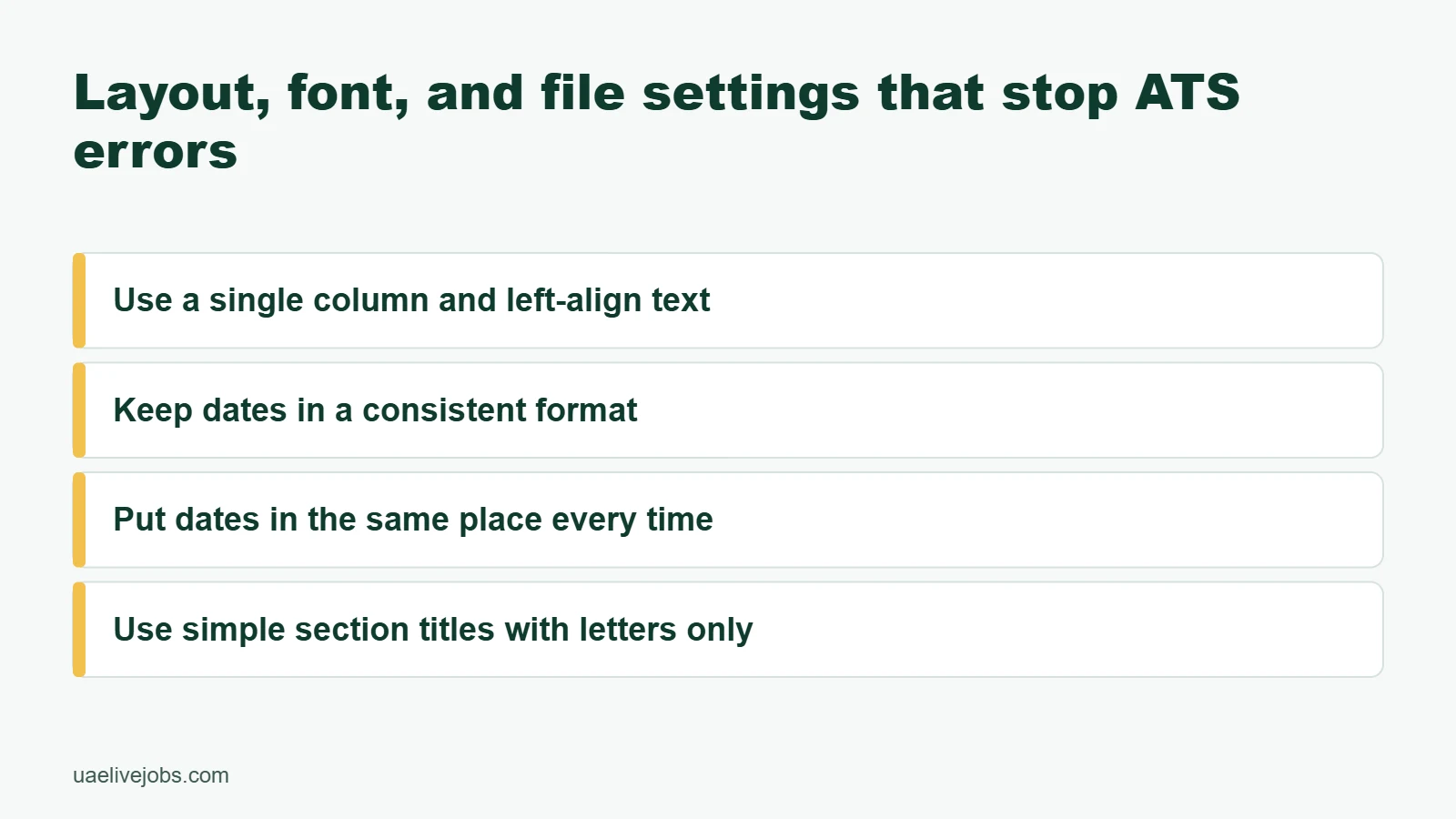
Layout, font, and file settings that stop ATS errors
Small formatting choices can create big parsing problems. Use these practical do’s and don’ts as your baseline.Do
Use a single column and left-align text.
Keep dates in a consistent format (pick one): MMM YYYY (Mar 2026) or MM/YYYY (03/2026).
Put dates in the same place every time (usually on the right or after location, but stay consistent).
Use simple section titles with letters only (avoid symbols like “★ Skills”).
Name your file clearly, for example: FirstLast_CV_2026.pdf.
Don’t
Don’t add charts, logos, QR codes, or infographic blocks.
Don’t place contact details in headers or footers.
Don’t use decorative fonts or heavy styling.
Don’t use special characters in headings that might break ATS parsing.
If you’re not getting responses, formatting is often one of the top mistakes applying for UAE jobs, especially for high-volume roles where ATS filters harder.
What UAE recruiters expect you to include at the top
In the UAE, recruiters often need “logistics” fast, not because they’re picky, but because hiring depends on sponsorship, joining speed, and basic eligibility.Include these near the top of page one:
UAE phone number with country code (+971). If you don’t have one, use your active number and add WhatsApp if relevant.
Current location (Dubai, Abu Dhabi, Sharjah, Ajman, Ras Al Khaimah, Fujairah, Umm Al Quwain, or “willing to relocate”).
Visa status (visit visa, residence visa, spouse visa, cancelled visa, and your notice period if employed).
Nationality (commonly requested in UAE hiring workflows).
Availability (immediate, 15 days, 30 days, or a clear date).
Target job title (match the job post wording when it fits).
Photos are optional. They’re more common in customer-facing roles (front desk, retail, hospitality). If you add one, keep it small and professional. Don’t let it push key details down the page.If you’re unsure which visa wording to use, review the UAE visa updates 2025-2026 for job seekers so you describe your status accurately.
Best UAE CV section order in 2026 (copy this structure)
Think of your CV like a storefront window. The top half must show the “best items” first, or people walk past. In UAE hiring, that means your summary, skills, and most relevant experience should appear early. ATS tools also tend to rank documents higher when job keywords appear in high-signal sections near the top.At the same time, don’t waste space with long objectives. Don’t place weak or irrelevant information before strong proof. If you have UAE or GCC experience, make it easy to spot, either in your summary (one short line) or in your most recent roles.A practical blueprint is to:
Put identity and eligibility details first (visa, location, availability).
Follow with a tight summary that matches the job title.
Add skills that mirror the job description.
Then show experience with measurable outcomes.
Keep personal details limited. In 2026, it’s still common to include nationality and visa status in UAE CVs. However, avoid adding anything not requested that could distract (for example, long family details). If a job post requests specific info, follow it.
If your best proof sits on page 2, you’re asking the recruiter to work harder than they need to.
ATS-friendly section order for most jobs
Use this order for most UAE roles in 2026 (administration, sales, logistics, finance, customer service, engineering, and IT):
Header (name, contact, links), plus visa status, nationality, availability, target role
Professional summary (3 to 4 lines)
Skills (hard skills first, then key soft skills)
Work experience (reverse-chronological)
Education
Certifications and licenses
Projects or internships (especially for freshers)
Awards and achievements (optional)
Languages (English level, Arabic a plus)
References (only if requested, otherwise omit or write “Available on request”)
Place UAE experience where it’s impossible to miss. For example, add “UAE experience” as a short phrase in your summary, or include Dubai or Abu Dhabi next to the company location. Also mirror industry keywords in your skills and bullets, such as “customer complaints handling,” “VAT filing,” “AutoCAD drawings,” “CRM pipeline,” or “inventory reconciliation,” but only if they’re true for you.
When to change the order for freshers, career changers, and senior roles
The “best” section order changes when your strongest proof changes.Freshers (or little experience): Put Education and Projects higher because that’s your proof. A good order is Header, Summary, Education, Projects/Internships, Skills, then any part-time work. Add coursework only if it matches the job.Mini example: A fresh graduate applying for a Junior Data Analyst role should place “Projects: Sales dashboard in Power BI” above unrelated part-time work.Career changers: Lead with Summary and Skills, then Projects, then Experience. Your experience section should highlight transferable wins, not only job duties.Mini example: A retail supervisor moving into office administration can highlight scheduling, reporting, vendor coordination, and customer issue resolution.Senior leaders: Keep the Summary stronger and add a short “Selected Highlights” section before the full experience list. Still keep it short. A long biography pushes decision-makers away.Mini example: “Selected Highlights: Reduced operating cost 12%, led team of 45, opened 3 new sites in GCC.”
ATS-friendly UAE CV template for 2026 (with what to write in each part)
This template is designed for ATS scanning and UAE recruiter expectations. Copy it, then tailor it to one job at a time.Before you edit, pull 10 to 15 phrases from the job description and plan where they fit naturally:
2 to 4 in the Professional Summary
6 to 10 across Skills and Work Experience bullets
1 to 2 in Certifications or Projects (when relevant)
Good keywords are usually nouns and tools, not buzzwords. Examples include: “invoice processing,” “reconciliation,” “cash handling,” “CRM (Salesforce),” “SAP,” “Power BI,” “AutoCAD,” “preventive maintenance,” “client onboarding,” “UAE VAT,” “purchase orders,” “stakeholder management,” and “customer complaint resolution.”For bullets, use this simple formula: Action verb + task + result + number
Example: “Reduced month-end closing time by 2 days by improving reconciliation checks.”
Copy-ready template in Markdown
FIRST LAST NAME
Dubai, UAE (or Abu Dhabi, UAE) | +971 XX XXX XXXX | email@example.com | LinkedIn: linkedin.com/in/usernameVisa Status: (Visit Visa, Employment Visa, Spouse Visa) | Nationality: (Your nationality) | Availability: (Immediate, 30 days)Target Role: (Match the job title, for example: Accounts Payable Accountant)Professional Summary
(3 to 4 lines. Include years of experience, industry, tools, and 1 to 2 measurable strengths.)
Example structure: “(Job title) with (X years) experience in (industry). Skilled in (tool 1, tool 2) and (core task). Known for (measurable result). Available (notice period) in UAE.”Core Skills
(Hard skill 1, hard skill 2, hard skill 3)
(Tools: SAP, Excel, Power BI, AutoCAD, CRM, only if true)
(Soft skills that match the job, keep it short: stakeholder communication, time management)
Work ExperienceJob Title | Company Name, City, Country (or UAE) | MMM YYYY to MMM YYYY
(Achievement bullet with numbers)
(Achievement bullet with tool and result)
(Scope bullet, what you owned day to day, keep it specific)
Job Title | Company Name, City, Country | MMM YYYY to MMM YYYY
(Achievement bullet)
(Achievement bullet)
Education
Degree Name, Major | University/College | City, Country | YYYYCertifications and Licenses
Certification Name | Issuer | YYYY (Add license number if relevant)Projects (Optional)
Project Name | Tool used | YYYY
(One line on outcome and what you built or improved)
Languages
English: (Basic, Intermediate, Advanced, Fluent, Native)
Arabic: (Basic, Intermediate, Advanced, Fluent, Native)References
Available on request (or omit unless the job asks)
Bullet points that rank better in ATS and sound strong to humans
Strong bullets help twice. ATS picks up the keywords, and recruiters see proof fast.Use these rules:
Start with a strong verb (managed, reduced, built, improved, resolved, delivered).
Add numbers when possible (AED, %, time saved, volume, accuracy rate).
Mention tools only if you can discuss them in an interview.
Mirror the job title and job terms (write “Customer Service Executive” if that’s the posted title).
Keep most bullets to one line, two lines max when needed.
Avoid “I” and “my,” write in clean action style.
Don’t repeat the same verb in every bullet, rotate them.
Two UAE-style sample bullets:
Sales Executive: Increased monthly revenue by 18% by improving CRM follow-ups and upselling add-on services to repeat clients.
Accountant: Reduced invoice errors by 25% by tightening three-way matching and improving vendor document checks before posting in SAP.
A 30-second check before you send your CV
A strong UAE CV in 2026 is simple on purpose. Use the right section order, place UAE header details (visa status, nationality, availability) near the top, and keep experience reverse-chronological. Add keywords naturally, skip tables and graphics, and keep dates consistent across roles.Before you submit, do a 30-second check: 1 to 2 pages for most roles, clean file name, correct file type, and one final proofread for spelling and phone number accuracy. Then take the next step: tailor your ATS-friendly UAE CV to one job post, submit, and repeat that process for every serious application.
Farooq Malik
Farooq Malik is the founder and editor of UAE Live Jobs, an independent guide hub for people working in the United Arab Emirates. He researches and writes practical guides on labour rights, pay, visas, CVs and job applications, building each one on official sources such as MOHRE, ICP, GDRFA and the UAE government portal (u.ae). Every guide is checked before it's published and updated when the rules change. You can reach Farooq at info@uaelivejobs.com.