Choosing between a free zone job and a mainland job in the UAE can feel like picking the right lane on a busy highway. Both get you forward, but the exits, speed, and rules aren’t the same.In plain English, a free zone company is licensed inside a specific economic zone (for example, DMCC or JAFZA), and its operations are built around that zone’s rules. A mainland company is licensed to operate across the UAE market and typically works under MOHRE processes for employment matters.This 2026 guide compares what matters to job seekers: where you can work day to day, visa rules and quotas, switching jobs, legal protections, and what to check in an offer. The UAE still has no personal income tax, so your decision is less about take-home tax and more about job options, mobility, and employer limits.
Free Zone Vs Mainland Jobs In UAE 2026
An illustrative view of UAE areas often associated with free zones versus mainland activityBefore details, here’s the quick comparison most candidates need when filtering offers. Think of it as the “commute test” plus the “career options test.”
Retail, local services, UAE market sales, larger multi-branch firms, government-related work
Visa scaling
Often starts with a limited visa allocation per package
Often scales with office space and company setup
Emiratisation impact (2026)
Generally exempt from targets
Some companies must meet Emiratisation targets
Dispute channel
Can be via free zone authority or special courts in some zones
Often via MOHRE labor channels
The takeaway is simple: free zone roles can be perfect if your work stays zone-based and international-facing. Mainland roles usually fit jobs that move around the UAE, serve local customers, or scale teams fast. Next, each point gets the full explanation.
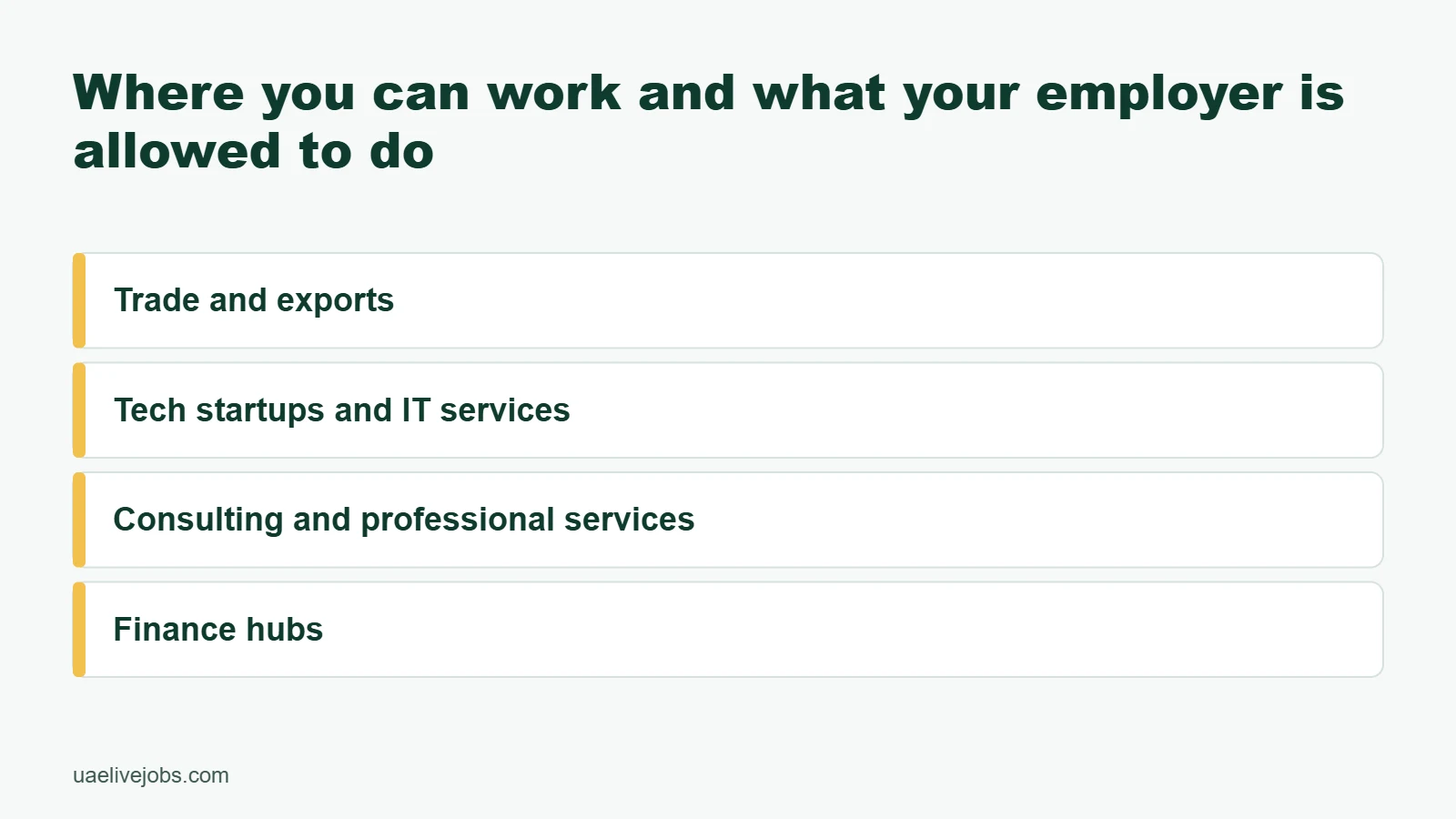
Where you can work and what your employer is allowed to do
For most employees, the biggest real-world difference is not the contract wording. It’s where your work “counts” as legal work, and where your employer can send you without extra steps.Mainland companies generally operate across the UAE. That means meetings in Dubai one day, a site visit in Sharjah the next, and a client workshop in Abu Dhabi after that. If your role depends on being physically present with customers, vendors, or projects, this flexibility matters.Free zone companies, by design, sit inside a defined area with its own authority and licensing structure. Many free zone jobs are still hybrid or field-based in practice, but the company’s default footprint is the zone. As a result, some work outside the zone can trigger additional approvals.Also, consider how business focus shapes your daily work. Free zone firms often sell internationally, export goods, or provide services to global clients. Mainland firms often focus on the UAE consumer market, local B2B services, or regulated sectors that require onshore activity. Your career exposure changes with that client mix.
If a job requires regular client site visits across the UAE, treat “where you’re allowed to work” as a contract-level issue, not a casual detail.
Work location rules, client sites, and temporary permits
Free zone employees typically work inside the free zone, on the company’s registered premises, or within facilities approved by the zone. When the role includes frequent mainland client visits, the company may need a temporary work permit or similar permission to keep things compliant.Costs vary by authority and purpose, but a commonly reported range for such permits is AED 500 to AED 1,000. Some employers cover it automatically, while others avoid roles that trigger it. Either way, ask early because it affects how smoothly you can do the job.Ignoring the rules can backfire. Compliance checks do happen, and penalties can be serious for companies and employees. You don’t need to memorize regulations, but you do need clarity: will you work only in the zone, or will you regularly work on mainland sites?A good way to confirm is practical, not legal. Ask HR to describe a normal week. Then ask where those activities happen and whether any permits are required for off-zone work.
Which jobs tend to sit in free zones vs on the mainland in 2026
In 2026, the pattern is still easy to spot once you look at how the employer makes money.Free zone jobs are common in:
Trade and exports (import-export firms, logistics coordinators, procurement for regional distribution)
Tech startups and IT services (product teams, cloud roles, data work, SaaS sales for non-UAE markets)
Consulting and professional services (advisory, marketing services, niche B2B consulting)
Finance hubs (roles in zones like DIFC or ADGM, where applicable)
Mainland jobs are common in:
Retail and local services (store operations, salons, clinics, maintenance, local delivery)
Customer-facing sales (UAE market account management, field sales across emirates)
Companies targeting the local UAE market (FMCG distribution, local B2B suppliers)
Government-related work (vendors and contractors that need mainland access)
If you’re aiming for public sector pathways, it helps to understand how hiring works and where roles appear. This guide on UAE government jobs 2026 apply guide is a solid starting point.
Visas, hiring quotas, and how easy it is to switch or grow
Most job seekers only notice visas when something delays onboarding. In reality, visa capacity shapes how fast teams grow, how stable your department feels, and how easily a company can add headcount after winning new work.Both free zone and mainland employers sponsor standard employment visas. The difference is the system behind it. Mainland employment processes often run through MOHRE pathways, while free zones often use their own authority workflows, even if the residency file connects into federal systems.Switching jobs in the UAE is also a “process” decision. When the employer has clear quota capacity and an experienced PRO or HR team, transfers and new visas tend to move faster. When quota is tight, even a great offer can turn into weeks of waiting.If you want a realistic picture of onboarding timing in 2026, keep a reference guide handy. The Emirates ID and residency timeline for UAE new hires explains what normally happens week by week and what causes delays.
Visa quotas and scaling, why office space matters more on the mainland
Mainland visa capacity often connects to practical setup items like office space and company classification. Put simply, a company with larger premises and established compliance usually has an easier time adding visas. That’s why mainland employers with multiple branches often scale teams faster.Free zone packages, on the other hand, commonly start with a limited visa allocation. Many licenses begin with a small number of visas (often in the 1 to 6 range), then increase through paid upgrades or larger facility packages. For a job seeker, this matters because a firm that runs “at quota” may delay hiring even when business is strong.Team size also affects career growth. If you join a company that can’t easily add visas, promotions can turn into title changes without real team expansion. In contrast, a firm that can hire quickly often creates new roles, new layers, and clearer manager tracks.Before you sign, ask one direct question: “Do you have visa quota available for this role today?” It sounds blunt, but it saves time for everyone.
Emiratisation in 2026 and what it means for expat job seekers
Emiratisation policies continue to shape mainland hiring decisions in 2026. Some private sector mainland companies, especially in certain categories, must meet targets for employing UAE nationals in skilled roles. Targets are often discussed as reaching around 2% of skilled roles by 2026, tracked through MOHRE systems, with consequences for non-compliance.Free zones are generally treated differently and are often exempt from these quotas. That doesn’t mean free zone hiring is easier, it just means the quota pressure usually sits elsewhere.For expats, the real effect is role selection. Mainland employers may reserve certain tracks for nationals, then focus expat hiring on technical, specialist, revenue-driving, or hard-to-fill roles. In many teams, this creates clearer structure, but it can also reduce openings in some generalist functions.If you’re job hunting from outside the UAE, entry rules and visit options can also shape your plan. The UAE visa policy updates 2025-2026 for job seekers breaks down how nationality-based rules can affect your travel and interview timeline.
Pay, benefits, and legal protections, what’s the same and what changes
Salary is the headline, but total value is the story. In the UAE, the best offers often look “normal” on base pay, then win on allowances, bonuses, medical coverage, and schooling support.Many core protections come from UAE federal labor law (including rules under Federal Decree-Law No. 33 of 2021). That’s why notice periods, end-of-service benefits, and contract basics can look similar across free zone and mainland roles. Still, dispute pathways and administrative processes can differ, and that difference matters when something goes wrong.When comparing two offers, focus on what changes your monthly life: housing allowance, transport allowance, variable pay, overtime approach, annual flight ticket policy, and medical cover details (network, co-pay, dependents). If you only compare base salary, you’ll miss the real gap.
Salary expectations in 2026, why the gap is usually smaller than people think
Free zone vs mainland doesn’t automatically decide your salary. Employers price roles based on skills, urgency, and budget. A senior accountant in a mainland retailer can earn more than a free zone accountant, and the reverse can also be true.Because there’s no personal income tax for employees, you should compare packages on a like-for-like basis. A clean way is “monthly cash plus predictable allowances.”As a general market reference, many mid-level professional roles in the UAE often land around AED 10,000 to 30,000 per month, with some specialist roles pushing AED 35,000+. These ranges vary widely by emirate, industry, and experience, so treat them as orientation, not a promise.Negotiation also works better when you talk in totals. If base salary is fixed, ask about housing, transport, annual bonus structure, and performance review timing. A small allowance can feel like a big raise when rent is due every month.
Labor law basics and where disputes get handled
Most day-to-day employment rights follow federal rules across the UAE. That includes written contracts, probation rules, notice periods, leave entitlements, and end-of-service gratuity basics.The key difference is often where disputes get handled. Mainland disputes typically start through government labor channels associated with MOHRE. Some free zones, especially financial free zones, can use separate legal systems or tribunals. DIFC and ADGM are common examples of zones with distinct courts for certain matters.This isn’t something to fear. It’s something to clarify. Before you join, ask HR which authority your employment falls under and what the dispute process looks like in plain terms.Also, keep your own records. Save your signed offer, contract, job description, and any official policy documents. If a problem appears later, documentation turns a messy argument into a clear timeline.For a bigger view of compliance steps tied to work permits and onboarding, this UAE work visa steps 2026 guide helps you understand what the employer must handle and what you must do on time.
Checks to make before you accept an offer
Free zone vs mainland jobs in the UAE isn’t about which is “better.” It’s about fit. Choose free zone roles if you want international-focused work, smaller teams, and a job that mostly stays zone-based. Choose mainland roles if you want UAE-wide mobility, more local-market options, and employers that can scale teams quickly.Before you accept any offer in 2026, make the decision concrete with a few checks. Ask about work location, client site work and permits, visa sponsorship timing, and which authority handles disputes.Here’s a short checklist to use before signing:
Work location expectations (zone-based or UAE-wide)
Client site visits and any temporary permit requirements
Visa sponsorship timeline and quota availability
Allowances (housing, transport, schooling) and bonus terms
Probation, notice period, and end-of-service terms
Which dispute channel applies (MOHRE, free zone authority, DIFC/ADGM)
A clear choice now protects your mobility later, and that’s what usually drives long-term career wins in the UAE.
Farooq Malik
Farooq Malik is the founder and editor of UAE Live Jobs, an independent guide hub for people working in the United Arab Emirates. He researches and writes practical guides on labour rights, pay, visas, CVs and job applications, building each one on official sources such as MOHRE, ICP, GDRFA and the UAE government portal (u.ae). Every guide is checked before it's published and updated when the rules change. You can reach Farooq at info@uaelivejobs.com.