

First, know the difference between government and semi-government roles (and why it changes your application)
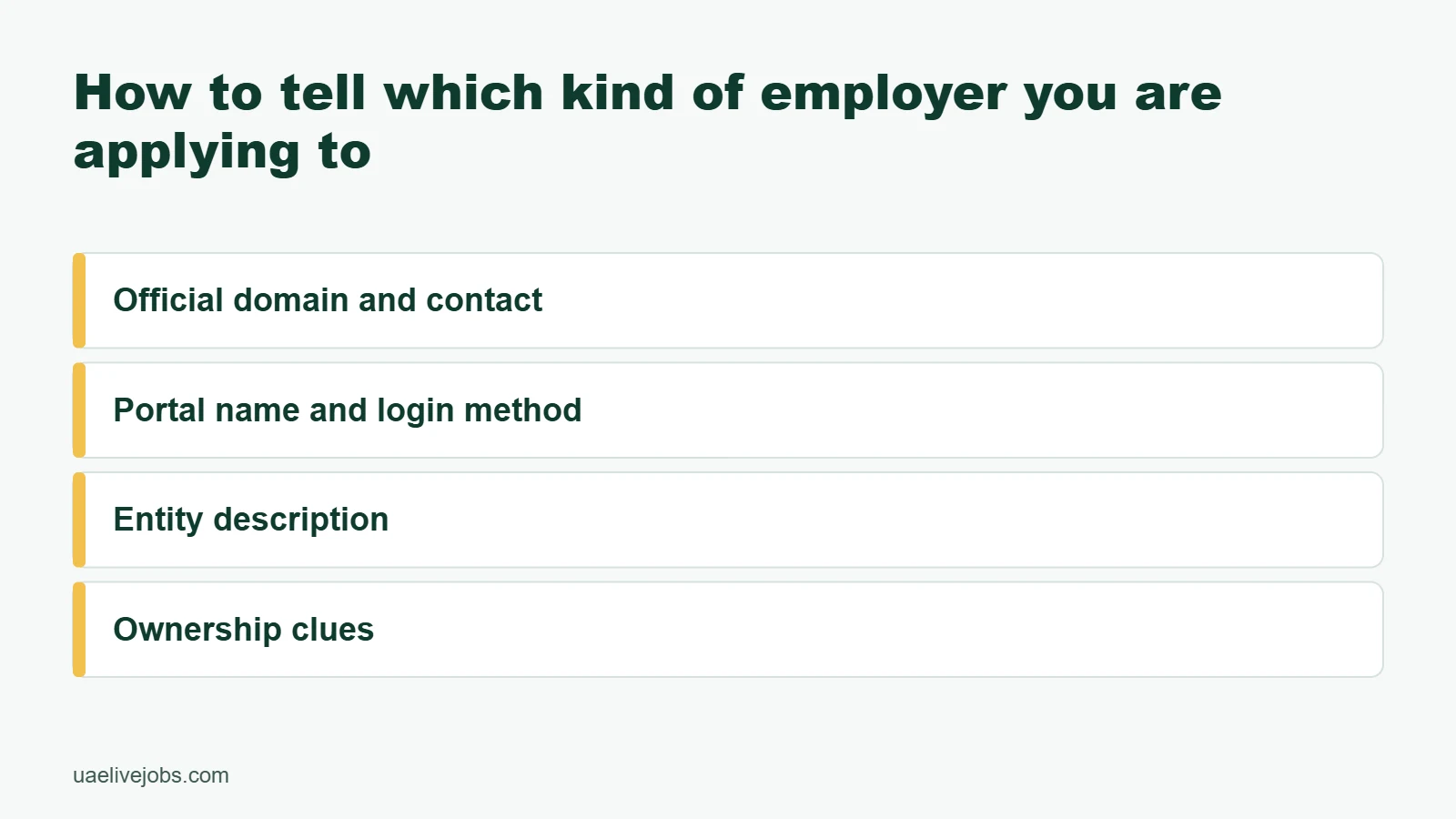
How to tell which kind of employer you are applying to
Start with quick, practical checks, because names can be confusing:- Official domain and contact: Government entities often use .gov.ae domains. Semi-government entities may use .ae or even .com, so confirm ownership in the “About” section.
- Portal name and login method: Federal roles often route through a central portal and may use UAE Pass for sign-in.
- Entity description: If the job ad says it operates under a ministry, a government authority, or an emirate’s HR department, it’s usually government.
- Ownership clues: Some semi-government employers mention “government-owned,” “state-owned,” or “established by decree.”
What changes for candidates, timelines, interviews, and documentation
Timelines often run longer in government hiring. It’s common to wait weeks, sometimes longer, between stages. Semi-government can move faster, but it still may involve approvals and background checks.Interviews also tend to be more formal. Expect structured competency questions, scenario-based prompts, and careful scoring. Written communication matters too. Clear, professional answers in screening questions can make a real difference.Here’s what commonly slows candidates down:- Missing documents (expired ID, unclear degree scans, incomplete experience letters)
- Incomplete portal profiles (blank fields, no job history dates, no attachments)
- Language gaps (job requires Arabic or strong English, but the CV doesn’t show it)
Where to find official UAE government and semi-government jobs in 2026 (without wasting time)
The fastest way to waste time is to rely on random social posts or unverified “government jobs” ads. Official portals filter for real eligibility and reduce scam risk. They also let you track your application status, which matters when timelines stretch.In 2026, plan your search like a routine, not a one-time effort. Create your profiles early, upload documents once, and set alerts where available. Then check weekly, because hiring drops often arrive in batches.Also, don’t assume one portal shows everything. A role posted by a local entity may only appear on that emirate’s HR portal. Meanwhile, some semi-government entities post only on their own careers pages.A simple habit helps: keep a shortlist of target entities and review them every week. When you spot a role that matches your background, apply quickly, because some listings close as soon as they collect enough eligible candidates.Federal government roles, the IRecruitment portal and FAHR
Many federal roles route through the IRecruitment portal, which serves as a central gateway for federal vacancies. You’ll often see the Federal Authority for Government Human Resources (FAHR) referenced alongside federal job postings and policies.While researching, you may also come across official sites connected to the public sector, such as MOHRE (labor and employment information), MOCE (community empowerment), and the UAE Accountability Authority. Those sites can help you confirm legitimacy, but you should apply only through the official process stated in the vacancy.For most federal applications, expect this pattern: register, complete your profile fully, upload required documents, then apply per vacancy. In many cases, you’ll need UAE Pass to sign in, so set that up early if you’re eligible.Emirate portals for local government jobs (Dubai, Abu Dhabi, Sharjah, Ajman, Ras Al Khaimah)
Each emirate runs its own hiring channel for local government entities. Dubai’s main portal is https://dubaicareers.ae, and it covers many government entities under one system.Other emirates maintain their own government job portals and HR services, including Abu Dhabi, Sharjah, Ajman (Kawader), and Ras Al Khaimah. Because portals and naming can change, use official emirate channels and confirm you’re on a genuine domain before you create accounts or upload documents.One last time-saver: apply on the portal that matches the employer. The same vacancy title might not appear across multiple portals, even when the job sounds similar.Requirements and documents for UAE government and semi-government jobs (2026 checklist)
Requirements vary by entity, but the pattern stays consistent. Public sector hiring values eligibility, proof, and clear records. If your documents don’t support your claims, your application can stall.First, expect nationality priority. Many government roles focus on Emiratization and list UAE nationals as the target. Still, expat openings exist, especially where skills are scarce or licensed professionals are needed.Education rules depend on the job grade. Some roles accept diplomas. Others require a bachelor’s or master’s degree. Certain regulated jobs also need active professional licensing (for example in healthcare). Language expectations are also role-based. Many jobs require strong English, while some require Arabic or prefer bilingual candidates.Treat every vacancy like its own set of rules. Don’t rely on assumptions from similar job titles.Eligibility basics, nationality priority, degrees, language, and experience
UAE nationals can apply across most government and semi-government roles, and many vacancies state this clearly. Expats often see openings in areas like:Healthcare services, IT and cybersecurity, engineering and infrastructure, education, and specialized technical operations.Experience requirements span a wide range. Some portals list fresh graduate roles and training programs. Others require five, eight, or ten plus years for senior posts. Because requirements can be strict, match the posting exactly. If it asks for a specific license, degree major, or years of experience, treat that line as a filter.If you’re planning your next move, understanding UAE salary trends for 2025-2026 can also help you set realistic expectations, especially when comparing public, semi-government, and private packages.Document checklist and profile prep before you click apply
Before you apply, build a clean folder and keep it updated. Most portals let you upload documents into your profile, which saves time later.Common documents include:- CV (government-style, structured, clear dates and roles)
- Passport (often for expats) or Emirates ID (as applicable)
- Degree certificates (and attestation if requested)
- Transcripts (only if the vacancy asks)
- Experience letters (with dates and job titles)
- Professional licenses or certifications (if the role is regulated)
- References (when requested)
How to apply step by step in 2026, from account setup to offer stage
Think of the UAE government job application process like boarding a flight. You don’t argue with the security steps, you prepare, arrive early, and keep your documents ready. The process rewards consistency.Start by researching roles and eligibility. Then build your portal profile properly once, so each new application becomes faster. After you apply, track status and stay patient. Processing time can be longer than private hiring, especially when approvals stack up.Also protect yourself. Scammers copy official names and use urgency to push payments or personal data sharing. Government and legitimate semi-government hiring should never require you to pay fees to “secure” a job.If anyone asks for money for a job offer, visa, medical, or “application activation,” treat it as a red flag and stop.
A simple application workflow you can repeat for every portal
- Pick target entities and roles based on your skills, location, and eligibility.
- Create your account (and UAE Pass where required), then complete every profile field.
- Tailor your CV to the vacancy language, especially duties and required skills.
- Answer screening questions carefully and keep wording consistent with your CV.
- Submit early, because some roles close quickly once they collect enough candidates.
- Track your applications using a simple spreadsheet (date, portal, job ID, status).
- Prepare for formal interviews even if you haven’t heard back yet.
Interview and assessment prep for formal government hiring
Many public sector interviews use competency questions. You may hear prompts like, “Tell us about a time you handled a difficult stakeholder,” or “How would you respond to a compliance issue?” Some roles add written tests, technical assessments, or scenario exercises.Preparation doesn’t need to be complicated. Review the job duties line by line, then prepare short examples from your experience. Bring printed copies of key documents if the interview is in person. Show respect in tone and timing, because formal settings notice those signals.Clarity matters more than big words. Keep answers structured: situation, action, result. When you don’t know something, say what you’d do to find the correct policy or escalate properly.Finally, use a strict anti-scam filter during the interview stage. Stick to official domains, confirm the entity’s contact details, and never pay to proceed. For extra protection, this guide on avoiding job scams in UAE job search breaks down the most common tricks used in 2026.Make Your CV Fit Government Roles
Government recruitment often depends on clear evidence that you can perform the advertised duties. A polished design matters less than accurate, easy-to-check information that matches government job requirements.
Show Results Without Making Big Claims
Use straightforward facts from your actual work. Name the systems you used, services you handled, reports you prepared, or requests you managed. Include relevant responsibilities involving confidentiality, compliance, records, or public service.
For example, a customer service candidate could write: “Handled email and phone enquiries, recorded cases in CRM software, and followed up with customers within agreed response times.”
A finance applicant could mention reconciliation, invoices, budget tracking, ERP systems, compliance checks, and audit support. An IT applicant should name relevant platforms, certifications, programming languages, or security tools.
New Graduates Should Lead With Education and Projects
If you have limited work experience, don’t leave half the CV empty. Add internships, university projects, volunteering, student leadership, technical training, certifications, and relevant coursework.
Keep it truthful. A final-year project isn’t the same as full-time employment, but it can show useful skills and careful work.
For a seasoned professional, focus on recent roles and measurable responsibilities. Seniority should be clear from actual duties, scope, and results, not job titles alone. Use accurate dates so reviewers can verify your experience quickly.
Protect Yourself From Government Job Scams
An official government application should never require you to pay a registration fee, visa fee, processing charge, training fee, or deposit to get hired. Never pay money to apply for a government job.
Be cautious if someone promises immediate hiring, an unusually high salary, or asks for bank details before a genuine offer. Scammers often copy ministry logos and job titles.

Photo by Pavel Danilyuk
Official channels should provide transparency by showing the employer, role details, application route, and any stated deadline without requesting payment.
If an offer looks suspicious, verify it through the federal entity’s official website or FAHR’s published contact route. You can also use MOHRE’s contact channels, including its call centre, for labour-related guidance where applicable. These channels don’t prove that a federal offer is genuine.