
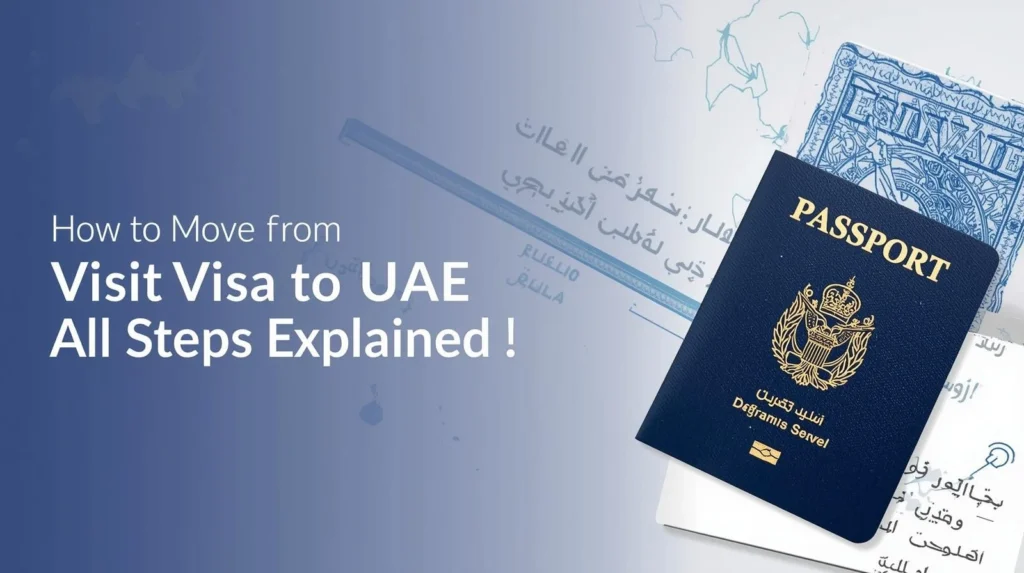
Yes, you can usually move from a visit visa to a work visa without leaving the UAE. Your new employer applies for a work permit, then asks the immigration authority to change your status from visitor to resident. You don’t apply for this yourself, and you can’t start working until the residence visa and work permit are issued.
This guide explains each step, who does what, how long it normally takes, and what to do if your visit visa is about to run out.
What “change of status” means
A visit visa lets you stay in the UAE for tourism, family visits or job hunting. It does not let you work. When an employer hires you while you are already in the country, the immigration authority can switch your file from “visitor” to “employee” without you flying out and back in. That switch is called a change of status.
In Dubai the residence side is handled by the General Directorate of Residency and Foreigners Affairs (GDRFA). In the other emirates it’s handled by the Federal Authority for Identity, Citizenship, Customs and Port Security (ICP). The work permit always comes from the Ministry of Human Resources and Emiratisation (MOHRE) for mainland jobs, or from the free zone authority for free-zone jobs.
Four checks before your employer starts
- A signed offer from a licensed company. For a mainland job, MOHRE’s offer letter is the document you sign first. Its terms should match the contract you sign later. Our guide on offer letter vs employment contract shows what must match.
- Enough time left on your visit visa. Note the exact expiry date and give it to HR on day one. The application should be submitted while your visa is still valid.
- A passport valid for at least six months. A passport close to expiry can delay or stop the residence visa.
- No work until the permit is issued. Attending interviews is fine. Doing trial shifts or “starting while the visa is processed” is not, and it puts both you and the company at risk.
Step by step: visit visa to employment visa
- Offer and contract. You accept the offer and sign the MOHRE offer letter (mainland) or the free zone’s equivalent. Read the salary split carefully: your basic salary drives gratuity and leave pay later.
- Work permit application. The employer applies to MOHRE. In emirates covered by the government’s Work Bundle service, the work permit and residence steps are filed together, which cut the process from seven visits and 16 documents to two visits and five documents.
- Entry permit and change of status. Once the work permit is approved, the employer applies to GDRFA or ICP to change your status inside the country. You normally stay in the UAE throughout. If an employer tells you to exit and re-enter, ask why: it is sometimes needed for specific visa types, but it shouldn’t be the default.
- Medical fitness test. You attend an approved government health centre for a blood test and chest X-ray. See our UAE medical fitness test guide for what to bring.
- Emirates ID biometrics. You give fingerprints and a photo for your Emirates ID. Since 2022 the UAE no longer puts a residence sticker in your passport. Your Emirates ID and the digital visa record are the proof of residence. Our Emirates ID process guide covers this step.
- Residence visa and labour contract. The residence visa is issued and, for mainland jobs, you sign the MOHRE labour contract. Only now can you legally start work.
How long it usually takes
| Step | Who does it | Typical time |
|---|---|---|
| Offer letter signed | You and HR | 1 to 3 days |
| Work permit approved | Employer with MOHRE or the free zone | A few working days |
| Change of status | Employer with GDRFA or ICP | A few working days |
| Medical test and Emirates ID biometrics | You attend; employer books | 2 to 7 days |
| Residence visa issued | Immigration authority | A few working days after medical results |
Most people finish in two to four weeks. Public holidays, missing documents, attestation of certificates for skilled jobs, and medical retests are the usual causes of delay. Treat these as typical ranges, not promises: each employer and emirate works at its own pace.
Who pays for the work visa
The employer pays. Under the UAE labour law, a private-sector employer may not charge a worker for recruitment or employment costs, and that includes the work permit and residence visa. If someone asks you to pay for “your visa” before you can join, read our guide on UAE recruitment fees before you send any money.
Official government fees for visas are listed on the u.ae visa fees and fines page. Typing centres and PRO companies add their own service charges on top.
If your visit visa is about to expire
- Tell HR the date immediately. Many delays happen because the employer didn’t know the deadline.
- Ask whether the application has been submitted. A submitted change-of-status application is different from a promise to apply next week.
- Consider an extension. Some visit visas can be extended through ICP or GDRFA. An extension costs less than overstaying.
- Don’t overstay quietly. Overstay fines are charged for every day you stay past expiry, and an overstay can complicate your residence visa. Check your status and any fines on the ICP or GDRFA services before you assume all is fine.
Mistakes that cause rejections or fines
- Starting work before the residence visa and work permit are issued.
- Paying an agent for a “visa” that turns out to be a visit visa with no job behind it. Our job offer verification guide shows how to check an offer first.
- A job title in the permit that doesn’t match your qualifications, which can trigger attestation requests or rejection.
- Names spelled differently on your passport, degree and offer letter.
- Letting the visit visa expire while waiting for the employer.
How to check your application
You can track the visa application and its validity on the official u.ae tracking page, which links to the ICP and GDRFA services. For a mainland job, MOHRE’s enquiry service shows whether a work permit or labour contract has been issued in your name. Ask HR for the application or transaction number so you can check without calling them.
Sources
- Ministry of Human Resources and Emiratisation (MOHRE)
- Federal Authority for Identity, Citizenship, Customs and Port Security (ICP)
- GDRFA Dubai
- u.ae: visa fees and fines
- Federal Decree-Law No. 33 of 2021 on labour relations
General information only, not legal advice. Fees and procedures change; confirm current requirements with your employer and the authority handling your visa.