
Last checked: 11 October 2026, against MOHRE’s Tawjeeh guidance and UAE labour law.
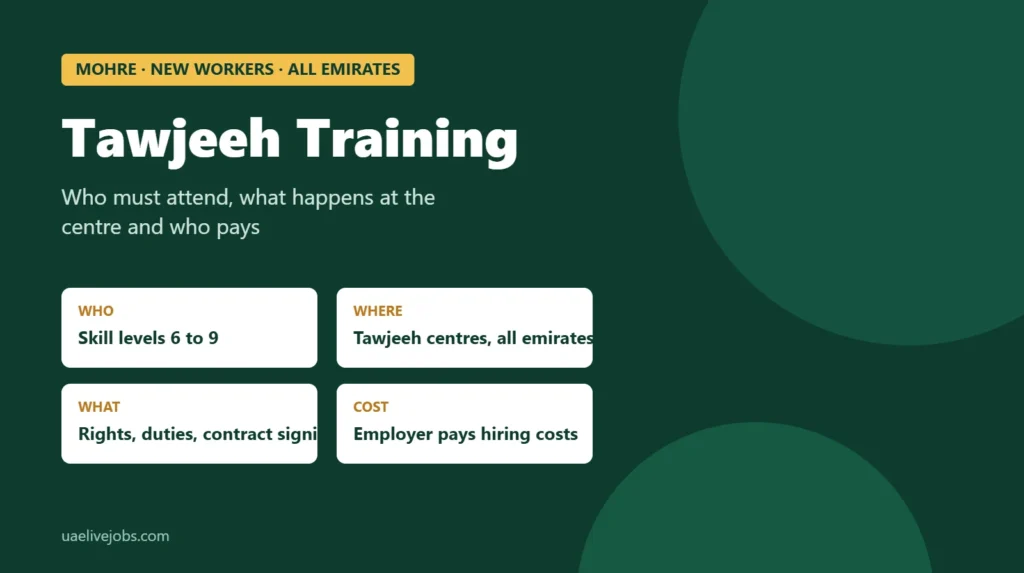
Tawjeeh training is a short awareness session for new workers, held at Tawjeeh centres licensed by the Ministry of Human Resources and Emiratisation (MOHRE). It explains your rights and duties under UAE labour law, and it is where many workers sign their employment contract. It mainly applies to workers in MOHRE skill levels 6 to 9, such as drivers, technicians, construction workers and cleaners. Your employer arranges it, and you should not have to pay for it yourself.
This guide explains who must attend, what happens at the centre, what to bring, who pays and how Tawjeeh differs from Tasheel.
Tawjeeh training at a glance
| Question | Answer |
|---|---|
| What it is | A worker-awareness session and contract signing at a MOHRE-licensed centre. “Tawjeeh” means guidance in Arabic |
| Who attends | New workers and workers renewing a permit, mainly in skill levels 6 to 9 |
| Where | Tawjeeh centres in all seven emirates |
| Opening hours | Saturday to Thursday, 8am to 8pm, according to MOHRE. Pre-booking is available |
| Languages | More than 15 |
| Who pays | The employer. Workers must not be charged recruitment or employment costs |
| MOHRE call centre | 600590000 |
Who must attend Tawjeeh training
MOHRE’s Tawjeeh leaflet says workers coming to the UAE for the first time, and workers whose work permits are being renewed, attend a Tawjeeh centre to sign their employment contracts. The contract must match the job offer they received.
In practice this applies to workers in MOHRE skill levels 6 to 9:
| Skill level | Type of work | Examples |
|---|---|---|
| 6 | Skilled agriculture, forestry and fishing | Farm workers, gardeners |
| 7 | Craft and trades | Electricians, plumbers, carpenters, AC technicians |
| 8 | Machine operators and assemblers | Drivers, plant and machine operators |
| 9 | Elementary occupations | Cleaners, labourers, helpers, loaders |
Your skill level depends on the job title registered in your work permit application, not your degree. Ask HR which level your job is registered under. Older guides mention skill levels 3, 4 and 5. Those numbers come from MOHRE’s old five-level system, which was replaced by the current nine levels in 2022.
Tawjeeh is part of the MOHRE process for private-sector employers. If your employer is in the DIFC or ADGM, or you are a domestic worker or a government employee, a different system applies.
What happens at the Tawjeeh centre
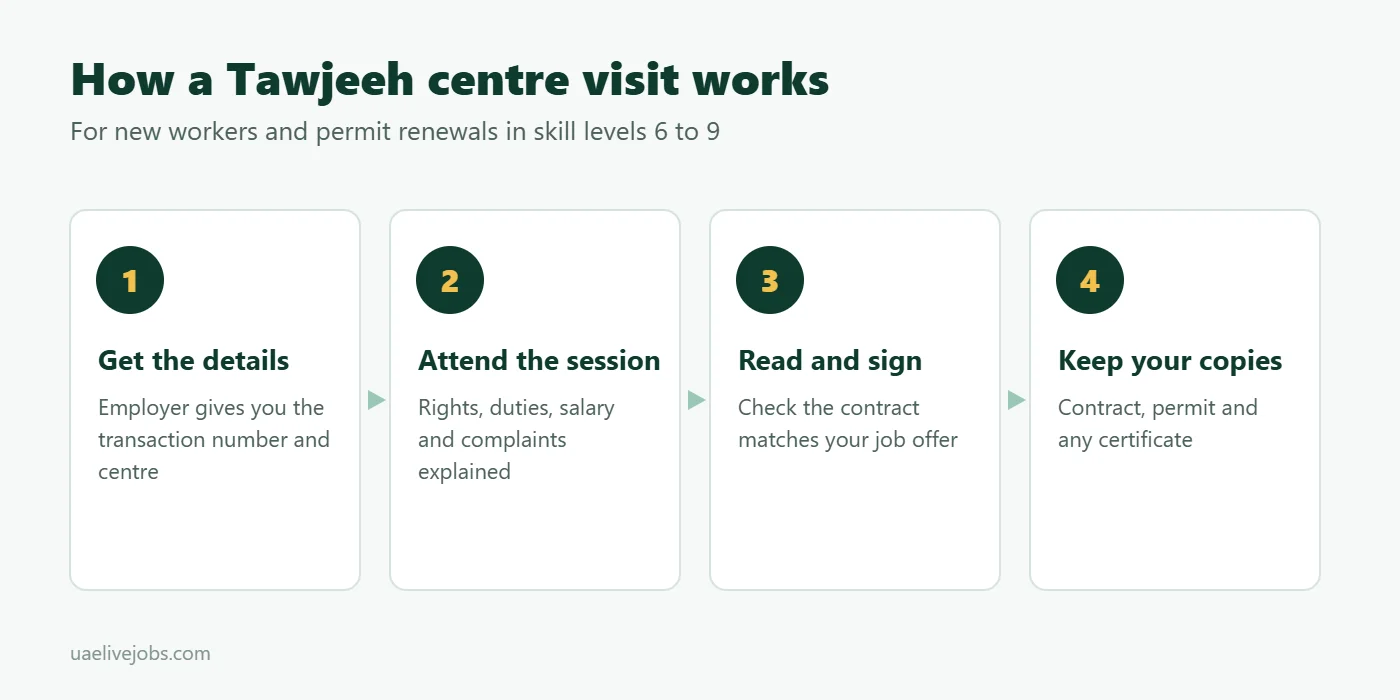
The visit has two parts: an awareness session and the contract signing.
The awareness session uses videos and presentations in your language. According to MOHRE and Gulf News reports, it covers:
- your employment contract, salary and working hours
- your rights and duties under UAE labour law
- health and safety at work
- UAE laws and culture
- what to do if your salary is late or your end-of-service benefits are not paid
- how to file a complaint with MOHRE
The contract signing follows. Read the contract before you sign. Check the employer name, job title, basic salary, allowances and working hours against your job offer. If something is different, ask the centre staff before you sign.
Attendance is recorded. A Gulf News report on the system explained that if your attendance is not completed, the labour card is not issued and you have to attend again. Stay for the whole session.
How to attend: step by step
- Get the details from your employer. Ask HR for the transaction number of your contract or work permit and the Tawjeeh centre you should visit.
- Book or confirm the time. MOHRE says pre-booking is available. Your employer or the centre can confirm the slot.
- Go to the centre with your documents. Arrive early. Allow time for queues as well as the session itself.
- Attend the session and sign the contract. Choose a language you understand and ask questions about anything unclear.
- Keep your copies. Save a copy of the signed contract and any certificate or receipt on your phone, and give your employer what they need.
Documents to bring
MOHRE does not publish one fixed checklist, so confirm with HR. Workers usually need:
- original passport (and Emirates ID if you already have one)
- the transaction number or papers your employer gave you
- a copy of your job offer, so you can compare it with the contract
- your mobile phone with the number registered in your application
Keep your passport with you. Do not hand it to an agent who promises a faster process. Our guide on what to do if an employer holds your passport explains your rights.
Tawjeeh fee: who pays
MOHRE’s Tawjeeh leaflet does not list a fee for workers. Fees for the work permit and contract process are paid by the employer.
Article 6 of Federal Decree-Law No. 33 of 2021 bans employers from charging workers recruitment and employment costs, directly or indirectly. If anyone asks you to pay for Tawjeeh, or deducts it from your salary, ask for a written explanation and receipt, and read our guide on who pays recruitment fees.
Tawjeeh, Tasheel and Tadbeer: what’s the difference
| Centre | Who it serves | What it does |
|---|---|---|
| Tawjeeh | Workers and employers | Awareness sessions, contract signing and worker guidance |
| Tasheel | Employers and PROs | Processes MOHRE transactions such as work permits and contracts |
| Tadbeer | Families and domestic workers | Domestic worker recruitment and services |
Completing Tawjeeh does not mean your work permit or residence visa is approved. Your employer still has to finish those steps. You can follow progress on the MOHRE enquiry portal.
Mistakes to avoid
- Signing a contract that does not match your offer. Our offer letter vs contract checklist shows what to compare.
- Leaving before the session ends, which can mean attending again.
- Paying anyone for a Tawjeeh certificate without attending. Certificates are linked to your record.
- Ignoring a problem with your salary or contract later. Call MOHRE on 600590000 or the Labour Claims and Advisory Centre on 80084, and see our guide to MOHRE salary complaints.
Can Tawjeeh be done online, and what does it cost?
Is Tawjeeh training mandatory?
It is required when MOHRE’s process sends you to a Tawjeeh centre, which mainly applies to new workers and permit renewals in skill levels 6 to 9. Your employer will tell you if you need to attend.
Can I do Tawjeeh training online?
MOHRE describes Tawjeeh as an in-person session at a licensed centre. Ask your employer if you have been told otherwise.
How much does Tawjeeh cost?
MOHRE does not list a worker fee. Employment and recruitment costs are the employer’s responsibility under UAE law.
How long does the visit take?
MOHRE does not publish a fixed time. Plan for most of a morning or afternoon, including queues and contract signing.
What languages are available?
MOHRE says sessions are available in more than 15 languages, including the main languages of workers in the UAE.
Sources: MOHRE’s Tawjeeh leaflet and the labour law
Written by the UAE Live Jobs editorial team and checked on 11 October 2026 against MOHRE’s Tawjeeh centres leaflet, Federal Decree-Law No. 33 of 2021 and Gulf News reporting on MOHRE skill levels. Centre procedures can change, so follow the instructions from your employer and the centre. This is general information, not legal advice.