
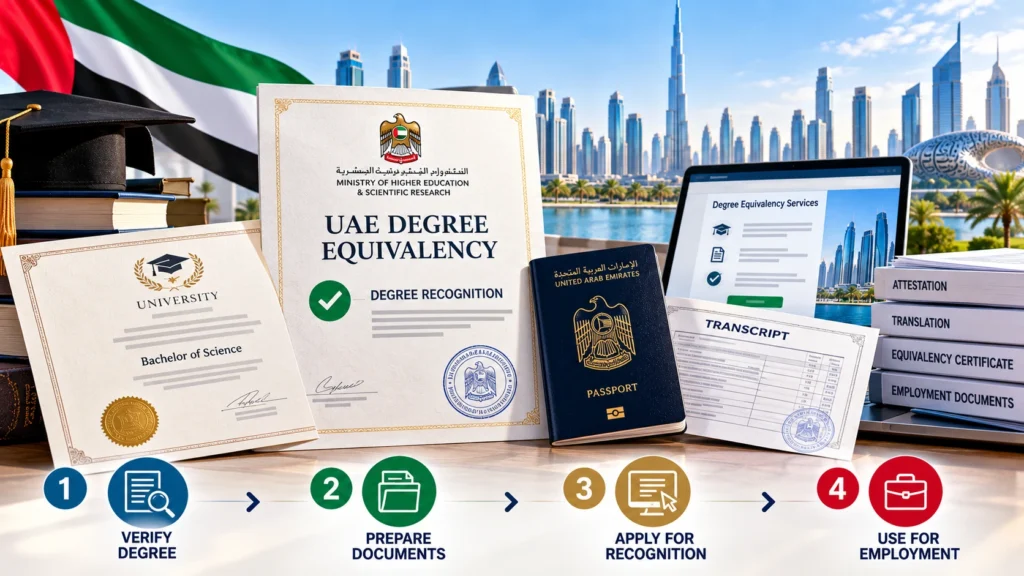
If a UAE employer asks for an equivalency certificate, it’s easy to confuse it with degree attestation. UAE degree equivalency now falls under a qualification recognition service, and the exact document requested matters.
Not every private-sector job needs recognition, but government roles, regulated professions and some employers may require it. Before paying for verification or sending original certificates, confirm what HR needs and follow the current official application route.
UAE Degree Equivalency for Employment: What It Means
University qualification recognition is the UAE government’s assessment of academic qualifications awarded outside the country, using a recognition framework and qualification verification. Its report can support employment, further study, visa applications and government services in higher education.
The Current Service and Responsible Ministry
Current UAE Government qualification recognition guidance names the service Recognition of University Certificates. The responsible authority is the Ministry of Higher Education and Scientific Research (MoHESR).
Older instructions may refer to the Ministry of Education, the former authority, or an Equivalency Certificate. In 2023, the Ministry of Education introduced University Certificates Recognition, replacing the earlier equivalency system. The phrase University Certificates Recognition may still appear in older materials, while Equivalency Certificate remains common in recruitment. Apply through the current MoHESR service.
When an Employer May Request Recognition
Recognition isn’t a universal condition for every UAE private-sector vacancy. It’s more common for government employment, professional licensing, regulated work and positions where the employer requires proof of university accreditation or lists recognition as a requirement.
Ask HR whether a requested Certificate of Recognition means the current recognition report, who will review it and when it’s due. A recruitment team may accept your degree initially but request additional paperwork during onboarding. Ministry recognition also doesn’t replace an employer’s assessment of your experience, subject knowledge or suitability for the position.
Recognition and Attestation: Two Different Requirements
UAE degree equivalency or recognition assesses the foreign qualification itself, while attestation checks whether a document’s signatures and seals are authentic.
An employer or licensing authority may request one or both checks. Attestation services confirm document authenticity, while qualification verification assesses the credential under the recognition framework. An attested degree certificate doesn’t automatically mean you have a recognition report, and recognition doesn’t complete every attestation requirement.
For an overseas certificate, attestation services may include university verification, home-country authentication, foreign ministry legalization, UAE Embassy or Consulate processing, and UAE Ministry of Foreign Affairs attestation. The required stages and order depend on the issuing country and receiving authority.
Check the UAE certificate attestation requirements separately if HR asks for an attested degree.
The 2023 recognition reforms removed the former requirement to attest preceding degrees. That change doesn’t create a blanket exemption from attestation for every document or employment process. The older label “Equivalency Certificate” isn’t the name of a current attested document. Confirm whether the receiving authority wants your degree, transcript or another record authenticated.
Which Foreign Qualifications Can Be Recognised?
The service covers foreign qualifications from accredited higher education institutions outside the UAE. Eligibility depends on the awarding institution, qualification, study mode and specialisation, so a genuine certificate alone doesn’t settle whether it can be recognised.
Accreditation and University Ranking
Check the institution’s university accreditation, especially if you studied through an affiliated college or overseas campus. Also verify the awarding body’s university accreditation with the relevant authority in its country. Confirm that it can award higher education qualifications.
Institutional ranking can affect recognition conditions. Under the linked MoE’s 2023 recognition framework, an institutional ranking from 1 to 200 generally required certificate-validity checks. The Ministry of Education introduced the framework as “University Certificates Recognition,” with exceptions for some specialized professions. Check current Ministry of Higher Education and Scientific Research guidance before relying on that historical threshold.
Don’t assume institutional ranking, or a place in a global ranking, automatically qualifies a degree. Check the current requirements for your particular qualification.
Online Degrees and Distance Learning
Distance learning and e-learning may be permitted under the recognition framework, but eligibility still depends on the qualification and study mode. Rules may differ for specialized professions, including engineering, medicine and law.
A qualification earned through distance learning, such as an online degree, doesn’t guarantee recognition or permission to practise. Check that the course meets relevant academic standards, and confirm any professional licensing rules before relying on it for employment.
If you’re choosing a course rather than applying with an existing degree, make these checks before paying tuition. Requirements for distance learning may include credential verification and qualification verification. A provider’s statement that its course is “internationally recognised” isn’t a UAE approval decision.
Documents Needed for Degree Recognition
Build a clear digital folder before opening the application. Treat the following as preparation guidance, not a universal upload checklist. Your qualification and the live service instructions determine what must be submitted.
Core Identity and Academic Records
Keep these academic records available:
- Prepare your final degree certificate with the qualification title, awarding institution and award date clearly visible.
- Obtain an official academic transcript showing your subjects, results and study details, along with any related academic records.
- Have your passport copy ready, with UAE identity or residence information available if the application requests it.
Check that scans of your academic transcript and other academic records are readable, including any reverse-side stamps. Save documents separately so you can upload the correct record without combining unrelated pages.
If your university has changed its name, retain an official explanation or supporting record. Use the exact qualification title shown on your degree certificate.
Supporting Documents: Follow Your Case’s Checklist
Additional requests may cover previous qualifications, transferred credits, study arrangements such as distance learning, name-change evidence, translations or qualification verification. Details about university accreditation may also be relevant to some applications. Submit supporting records when the service asks for them.
Older or case-specific checklists may mention an ICA Report, a university genuineness letter or the legacy term “Equivalency Certificate.” Don’t assume any of these are mandatory for every current application. The current guidance cited here doesn’t establish a universal requirement for them.
If one is requested, confirm the accepted format and issuing authority before ordering it. For documents in another language, check the required translation language and certification rules. An informal translation may not meet the receiving authority’s requirements.
How to Apply for UAE Degree Recognition
Start with the official MoHESR recognition service. Follow the current service instructions rather than an older MoE guide or an agent’s checklist.
- Confirm the purpose of your application. Ask whether HR needs academic recognition, attestation, professional licensing evidence, or several documents. If HR uses legacy terms such as “Equivalency Certificate” or “Certificate of Recognition,” confirm exactly what it means. Get the requirement in writing and establish the submission deadline.
- Open the service and review your requirements. Follow the current registration or sign-in instructions. Check the eligibility rules within the recognition framework, required documents, fees, and submission conditions before paying. Confirm whether qualification verification is required. Older guidance may call the service University Certificates Recognition, but use the live instructions.
- Complete any directed qualification verification. If the service directs you to an authorised provider, use that route for the separate credential verification stage. Keep the report and reference details. Don’t assume a provider named in old guidance remains authorised.
- Submit accurate details and requested files. Enter your university, qualification, study dates, and personal details as shown in your records. If relevant to your case, include distance learning details and make sure the files match your academic records. A genuineness letter may be requested in some cases, so upload one only if the service asks. Review your application before payment, then save the receipt and reference number.
- Track the application and respond to requests. Check the portal and registered email for queries. Supply missing information through the instructed channel. The current application results in a Ministry recognition report, even if HR calls the document an Equivalency Certificate. Save the report and share it with the employer or authority that requested it.
Keep qualification verification and Ministry recognition separate in your records. Completing qualification verification alone doesn’t mean the Ministry has issued a recognition report.
Avoid creating another application simply because the first is pending. Check its status and contact the service through its official support channel first.
Fees and Processing Times: What to Expect
There’s no reliable single total for every applicant’s recognition, verification and document preparation costs. Check the live service for current Ministry fees and separate qualification verification charges. Fees listed for the former Equivalency Certificate process may be outdated.
Your overall spending may also include university-issued transcripts, certified translations, attestation services or courier delivery. These may be separate stages under the recognition framework, alongside optional agency assistance. Request an itemised quote if someone handles documents for you.
MoE’s 2024 recognition system update reported up to 85% fewer required documents and a 50% reduction in transaction execution time. These historical improvements don’t guarantee an individual processing time.
University responses, incomplete records and additional checks can affect your processing time. Ask HR whether recognition must be ready before joining or by another stated deadline.
Don’t commit to a start date based only on an agent’s estimated approval time.
Common Mistakes That Can Delay Employment Paperwork
A genuine qualification can still face delays because of inconsistent details or missing evidence. Check the paperwork early, particularly when a job offer has a fixed joining date.
Names, Dates and Incomplete University Records
Compare your passport, certificate, academic transcript and application with your university’s academic records before submitting. Initials, spelling differences, changed surnames and incorrect dates of birth can cause questions.
If your name changed, prepare official supporting evidence and check whether it needs translation or authentication. Don’t edit a scan to make the names match.
Use accurate study and award dates. For qualification verification, ask the university registrar which office handles requests. Provide the requested consent or student details promptly so the university can locate your records.
Employer Requirements and Document Security
Tell HR accurately whether Ministry recognition is pending or issued. If an employer uses legacy wording such as “Equivalency Certificate,” ask which document it means. Don’t describe an attested certificate or verification report as completed Ministry recognition.
Keep recognition deadlines separate from the UAE employment visa application steps. HR should confirm whether an ICA Report is specifically required and how recognition fits your employment procedures and onboarding.
If an original certificate must be sent, obtain tracking details and a written return procedure. Never share your UAE Pass password or one-time verification code with an agent. Private assistance can help with paperwork, but it can’t guarantee a government recognition decision.
For HR teams, naming the exact required document in the offer or onboarding checklist helps candidates avoid unnecessary fees and last-minute delays.
Certificate equivalency in the UAE: attestation, online degrees and timing
Is UAE degree recognition the same as degree attestation?
No. Recognition assesses the qualification under the UAE framework, while attestation checks the authenticity of a document’s signatures and seals. An employer or authority may request one or both.
Is an Equivalency Certificate still issued?
The current service is called Recognition of University Certificates, and it results in a Ministry recognition report. If HR asks for an Equivalency Certificate, confirm whether it means this current report or another document.
Can an online degree be recognised in the UAE?
Distance learning may be permitted, but recognition depends on the qualification, study mode and applicable requirements. Check the current Ministry guidance and any professional licensing rules for your case.
How long does UAE degree recognition take?
Processing time can vary because of university responses, incomplete records or additional checks. Check the live service for current information, and don’t rely on an agent’s estimated approval time when planning a start date.