
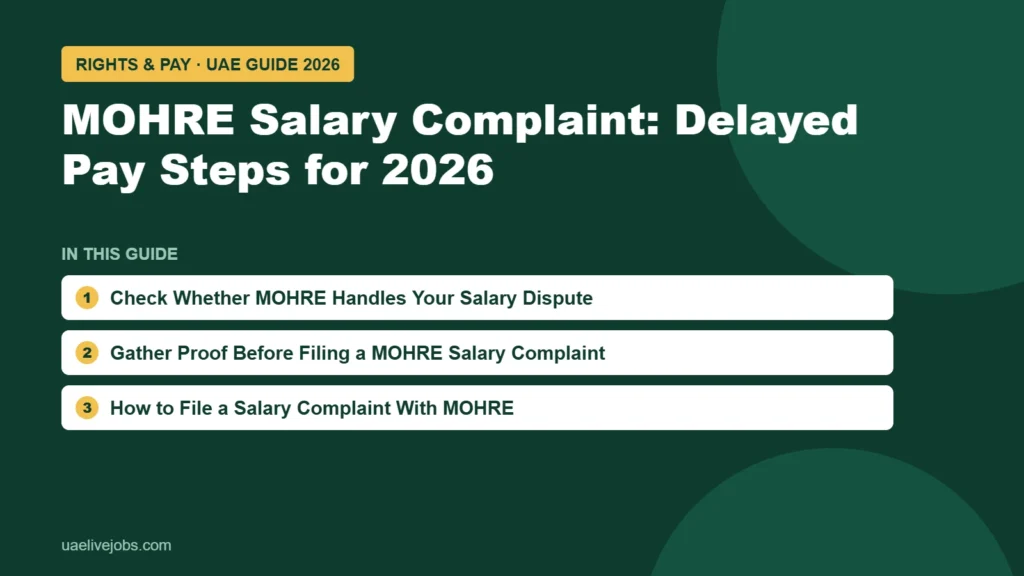
If your salary is late or unpaid, a mainland private-sector employee can file a complaint with the Ministry of Human Resources and Emiratisation (MOHRE). MOHRE then contacts your employer and tries to settle it, usually within about 14 days.
This guide covers UAE private-sector employment disputes under UAE labour law. Domestic workers, DIFC and ADGM employees, and employees in some free zones may follow different procedures.
Don’t wait until the missing amount becomes harder to prove. Keep your records, raise the matter clearly, and check the current official service page in 2026 before using the available channels and procedures.
Check Whether MOHRE Handles Your Salary Dispute
MOHRE handles many labour disputes involving employees of private-sector establishments registered with MOHRE. This includes delayed wages, unpaid salary, salary deductions, unpaid overtime, leave pay, end-of-service benefits, and other contract-related claims under UAE labour law. If gratuity is part of your claim, work out the expected amount first with our gratuity calculator so you know what figure to ask for. Our MOHRE enquiry guide shows which online service to use for each record.
The process is free for employees. However, the first question is simple: is your employer under MOHRE’s jurisdiction?
Mainland Employees Usually Start With MOHRE
If your employer is a private-sector establishment registered with MOHRE, this is normally the correct place to file. Check the employer’s licence, work permit, and contract to confirm its status.
You can also call the MOHRE Labour Claims and Advisory Centre on 80084 before submitting. The service can help you understand the complaint route and what information is needed.
Free Zone Employees May Need a Different Route
Not every free zone follows the same procedure. Workers in zones such as DMCC or JAFZA may need to begin with their free zone authority’s employment or mediation department.
DIFC and ADGM have separate employment legislation and dispute forums. Confirm the correct authority with the relevant free zone or court before filing.
Domestic workers follow a separate MOHRE framework. They may need to use the current domestic-worker complaint channel instead of the private-sector labour-complaint service.
Check your employer’s trade licence, work permit, or contract before filing. Filing with the wrong authority can waste valuable time when your salary is already overdue.
Gather Proof Before Filing a MOHRE Salary Complaint
A complaint is stronger when the facts are clear. You don’t need a thick file, but you should show what was agreed, what you received, and what remains unpaid.
Some records are commonly useful, while MOHRE may specifically request others. Follow the upload requirements in the current MOHRE service. The list below isn’t mandatory for every case.
Your agreed terms show your salary, job title, and payment dates. Account records can then show whether the money reached you.
Keep These Documents Ready
Prepare digital copies or clear photographs of the following:
- Your Emirates ID, passport details, and UAE mobile number.
- Your labour card number or work permit details, if available.
- Your signed employment contract and any salary amendment.
- Recent bank statements showing the relevant pay period, account holder, and missing credits where possible.
- Payslips, salary certificates, or WPS payment records.
- Emails, WhatsApp messages, or letters where you asked about delayed pay.
- A simple calculation of the unpaid wages, including the unpaid months and any amounts withheld.
The MOHRE Wage Protection System guidance explains how salary payments are monitored for covered workers. Coverage, payment methods, exemptions, and record availability can vary.
Where applicable, Wage Protection System records can help establish whether a covered employer transmitted wages. However, the absence of a WPS entry doesn’t automatically prove that no entitlement exists.
Arrange your evidence in a simple sequence: contract or offer terms, expected pay dates, actual bank credits, WPS records if applicable, and written requests to HR.
Write Down the Facts in Date Order
Avoid filing a complaint that only says, “My employer did not pay me.” Give MOHRE a short timeline instead.
For example: “My monthly basic salary is AED 3,500. My total salary is AED 5,000. I received no salary for July and August 2026. My calculation includes salary deductions of AED 500 recorded in August. I contacted HR by WhatsApp on 5 August and 18 August. No payment has been made.”
This makes it easier for the case officer to understand the dispute without guessing. Don’t exaggerate the amount or add claims you can’t support.
How to File a Salary Complaint With MOHRE
You can submit a MOHRE salary complaint through the Ministry’s digital channels or by phone. Options may include the MOHRE website, MOHRE smart app, call centre, and Labour Claims and Advisory Centre.
The official MOHRE worker rights page confirms that workers can obtain labour advice through 80084 and submit labour complaints through Ministry channels. For 2026, verify the current official website, app screens, phone numbers, and service availability before filing.
Follow These Steps When You Submit
- Log in through the MOHRE website or MOHRE smart app using UAE Pass or your available identity details.
- Select the service for registering a private-sector labour complaint. Use this option only if your employer falls within MOHRE’s jurisdiction. Domestic-worker, DIFC/ADGM, and free-zone cases may show different services or require another authority. Choose the issue that matches your case, such as delayed pay or unauthorised deductions.
- Enter your employer’s details, salary information, and the months that remain unpaid. Check every date and amount before continuing.
- Upload supporting documents when the channel requests them. Your contract and bank records are usually useful starting evidence.
- Submit the complaint and save the case reference number. Take a screenshot as well, especially if you file through the app. The filing service is generally free for employees, but any later court proceedings are separate.
- Monitor your SMS messages, email, and MOHRE account for updates. Answer calls from MOHRE promptly, even if the number is unfamiliar.
If you can’t use the digital service, contact the MOHRE call centre on 600 590000 or call 80084 for labour claims advice. Ask the agent to confirm the current submission option and phone number, because service screens and channels can change.
What Happens During the 14-Day MOHRE Process
After the complaint is registered, MOHRE reviews the information and contacts the employee and employer. It may ask either party for more evidence. The Ministry usually tries an amicable settlement through its conciliation process.
For an individual labour dispute, current official MOHRE service information describes a 14-day procedural framework after filing. This is a next-step expectation, not a promise that unpaid wages will reach your account within 14 days. The matter may then close, receive a Ministry outcome, or escalate. Where the applicable procedure allows a binding decision, that outcome still may not mean immediate payment.
Be Ready for the Employer’s Response
Your employer may say payment is pending, the company has cash-flow problems, you were absent, or that salary deductions were allowed. Don’t argue emotionally. Reply with records.
If the employer claims you received payment, ask for proof. If they claim you agreed to a reduced amount, ask where that agreement is recorded. A verbal promise is not the same as money in your bank account.
Termination during or after a complaint may raise a wrongful termination issue. MOHRE or the competent court must assess the facts.
Many cases end when the employer pays the outstanding amount or both sides agree on a written settlement. Read it carefully before accepting it. Make sure it identifies the exact amount and payment date. It should also state the scope of any released claims and what happens if payment is missed.
Track the Complaint Until It Closes
Keep your messages, documents, and notes of every phone call. You may need them if the matter moves to court.
An employer’s promise doesn’t close the case until MOHRE records the outcome or the amount is actually paid. Check the status through the same MOHRE channel used for filing. Provide your case reference number when asking, “Can you update me on my salary complaint?”
Respond promptly to MOHRE calls and settlement meetings. The Ministry’s 2026 dispute-resolution update provides broader context on the Ministry’s work. It doesn’t guarantee an individual outcome or payment timeline.
When MOHRE Decides or Refers the Case to Court
The value of your claim affects what happens next. Under the current UAE labour law framework, Federal Decree Law No. 33 of 2021, as amended by Federal Decree-Law No. 20 of 2023, MOHRE may issue a final executive decision when an individual claim does not exceed AED 50,000.
That route can cover unpaid wages, deductions, or other individual employment entitlements. The official term may be “final executive decision,” rather than “binding decision,” so rely on the wording in your MOHRE notice. Once final, the outcome may function as a binding decision and be enforced through the legal process.
Claims Above AED 50,000
Court referral is generally the next step when the claim exceeds AED 50,000 and no settlement is reached. MOHRE may refer the dispute to the competent labour court when it cannot resolve or decide the matter.
The referral is not the end of your responsibilities. If the referral notice sets a 14-day filing period, file with the labour court by that date. Otherwise, follow the deadline and filing method stated in the notice. Rely on that notice and current court guidance, not this article alone.
Article 5 of the same law generally exempts workers’ claims not exceeding AED 100,000 from court fees at the litigation and execution stages, subject to its conditions. Even where that exemption applies, confirm court fees, translation requirements, execution costs, and other charges with the competent court.
Consider legal advice if your salary claim combines salary arrears with an end of service gratuity or disputed commission. The same applies to compensation linked to alleged wrongful termination.
Can You Report Late Wages Anonymously?
An anonymous report and a salary recovery complaint aren’t the same thing. You may report a workplace issue without sharing every detail publicly, but MOHRE generally needs to identify you and your employer to investigate and recover your own unpaid wages.
Your employer will usually learn about the complaint because MOHRE must contact both parties. That can feel uncomfortable, especially if you still work there. Don’t assume a formal claim guarantees confidentiality or protection from retaliation. A salary claim cannot normally remain hidden from the employer.
Don’t Stop Working Without Advice
Some workers stop attending work after a salary delay. That choice can affect the case if the employer later reports absence from work.
Keep attending work where lawful and safe, unless you have a lawful reason not to, receive clear written advice, or MOHRE instructs you otherwise. Communicate your availability in writing and preserve attendance records, wage records, and messages to your manager.
Protect yourself with these steps:
- Keep attending work where lawful and safe.
- Confirm your availability in writing.
- Preserve wage, attendance, and related communication records.
- Don’t sign an unexplained settlement or resignation.
- Ask MOHRE about lawful work-status options.
If employment ends after the complaint, preserve any dismissal letter, termination notice, messages, attendance records, and other evidence. The facts will determine whether the termination was wrongful termination.
If your work permit is cancelled or suspended during a dispute, ask MOHRE whether you qualify for a temporary work permit. Eligibility, approval, employer-consent requirements, transfer rules, and the responsible authority can depend on your status and current rules. Get confirmation from MOHRE before starting with another employer. Don’t work informally. Free zone employees and domestic workers may follow different permit rules from the mainland private-sector process.
Filing a MOHRE complaint online: eligibility, documents and timing
Who can file a MOHRE salary complaint?
Private-sector employees whose employers are registered with MOHRE can generally use the Ministry’s labour-complaint channels for delayed wages, unpaid salary, deductions, and related claims. Free zone, DIFC, ADGM, and domestic-worker employees may need to use a different authority or procedure.
What documents are useful for a salary complaint?
Keep your employment contract, Emirates ID and work permit details, bank statements, payslips, WPS records where applicable, and messages to HR about the missing payment. Also prepare a simple calculation showing the unpaid months, expected salary, and any deductions.
How long does the MOHRE salary complaint process take?
Current official MOHRE service information describes a 14-day procedural framework for an individual labour dispute after filing. This is not a promise that the employer will pay within 14 days, because the case may require evidence, settlement discussions, or further legal action.
Can I file a salary complaint anonymously?
A report may be possible without publicly sharing every detail, but MOHRE generally needs to identify you and your employer to investigate and recover your unpaid wages. The employer will usually learn about the complaint because the Ministry must contact both parties.
What happens if my claim is more than AED 50,000?
If the claim exceeds AED 50,000 and no settlement is reached, MOHRE may refer the dispute to the competent labour court. Follow the deadline and filing instructions in the referral notice, including any stated 14-day period.