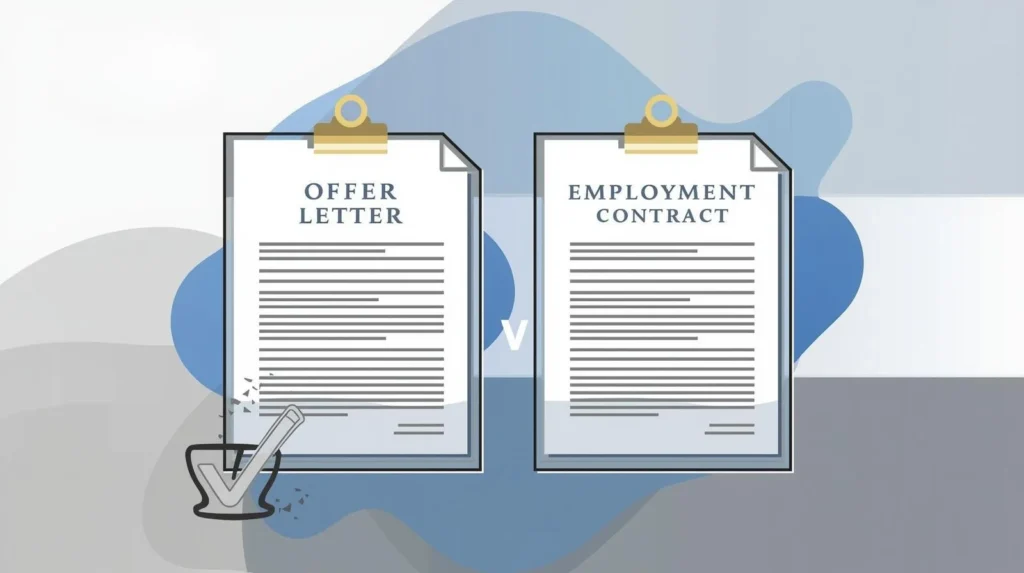
Most job problems in the UAE don’t start on day 30. They start on day 0, when the offer letter says one thing and the employment contract says another.This happens because UAE hiring often has three layers: a promise (often verbal), a job offer letter, and a signed employment contract that may also be filed through MOHRE (mainland) or a free zone authority (free zone employers). If the final contract doesn’t match what you accepted, you can end up stuck arguing after you’ve resigned, moved, or started the visa process.This 2026 checklist is built for speed. You can use it in about 10 minutes before you sign. Compare documents line by line, then ask for fixes in writing.Also, keep copies of everything: emails, offer PDFs, WhatsApp messages, and the final signed contract. If a change is agreed, ask HR to confirm it in writing, not “don’t worry, it’s fine.”
Offer letter vs employment contract in the UAE, what each document really does
An offer letter is usually the “headline version” of the job. It’s meant to confirm that the company wants to hire you, and it often helps start internal approvals. In many cases, it also kicks off visa steps, background checks, or onboarding planning.An employment contract is the full agreement that sets the rules once you join. It’s the document both sides rely on when there’s a dispute about pay, notice, leave, or termination. On the mainland, employers often register a version of the contract in the MOHRE system as part of the work permit process. In free zones, the authority may require its own contract template and approvals.That “official” version matters because it can become the reference during visa processing and labor records. If your offer letter promises one package but the filed contract shows another, you don’t want to discover it after you’ve already handed in your resignation.A common flow looks like this: verbal discussion, offer letter, negotiation by email, contract signing, then work permit and visa steps. If you’re joining from outside the UAE, the visa timeline becomes part of the risk. If you’re inside the UAE on a visit visa, timing and document accuracy matter even more (this guide on convert visit visa to work visa UAE helps you understand the typical steps and why the contract details get checked).
What an offer letter usually covers, and what it often leaves out
Offer letters usually include the basics: job title, start date, location, salary package summary (sometimes as “total package”), probation period, and a short benefits list. Some also mention working hours, a reporting line, or a simple notice period.Still, many offer letters leave out the “fine print” that changes your real take-home pay and daily workload. Common gaps include overtime rules, bonus conditions, commission triggers, leave policy details, deductions, training payback terms, and non-compete wording.Those gaps create room for later changes. Think of it like agreeing to rent an apartment based only on the monthly rent, then discovering extra fees after you sign the lease. The offer letter might be honest, but it’s often incomplete.
What an employment contract controls after you sign, including the official version filed for your visa
The employment contract is the binding document for employment terms. It can include salary breakdown, allowances, hours, leave, notice, termination terms, confidentiality, and post-employment restrictions.Because contracts may be bilingual, make sure you understand the language you sign. If you’re not fully comfortable, ask for clarification in writing and request a translated copy you can review. Don’t rely on verbal explanations of legal text.When possible, ask to review the final contract before you resign from your current job. If HR says “we only issue the contract after you join,” push back politely. You can’t make a safe decision without seeing the full terms, especially if relocation, family plans, or probation risk is involved.
The 2026 UAE checklist, what must match line-by-line before you sign
Before you sign anything, compare the offer letter and contract like you’re matching two receipts. Don’t scan for “similar meaning.” Match the numbers, dates, and conditions. Watch for small words that change everything, like “up to,” “discretionary,” “as per company policy,” or “may be amended.”A quick way to stay organized is to mark each item as Match, Mismatch, or Missing. Missing is a problem too, because it often gets filled later in a way you didn’t expect.Here’s a compact view of what should align:
If you’re unsure whether the offer is competitive, check broader context like 2025-2026 UAE pay trends for employees. It won’t validate your contract, but it can help you spot unrealistic numbers or missing allowances.
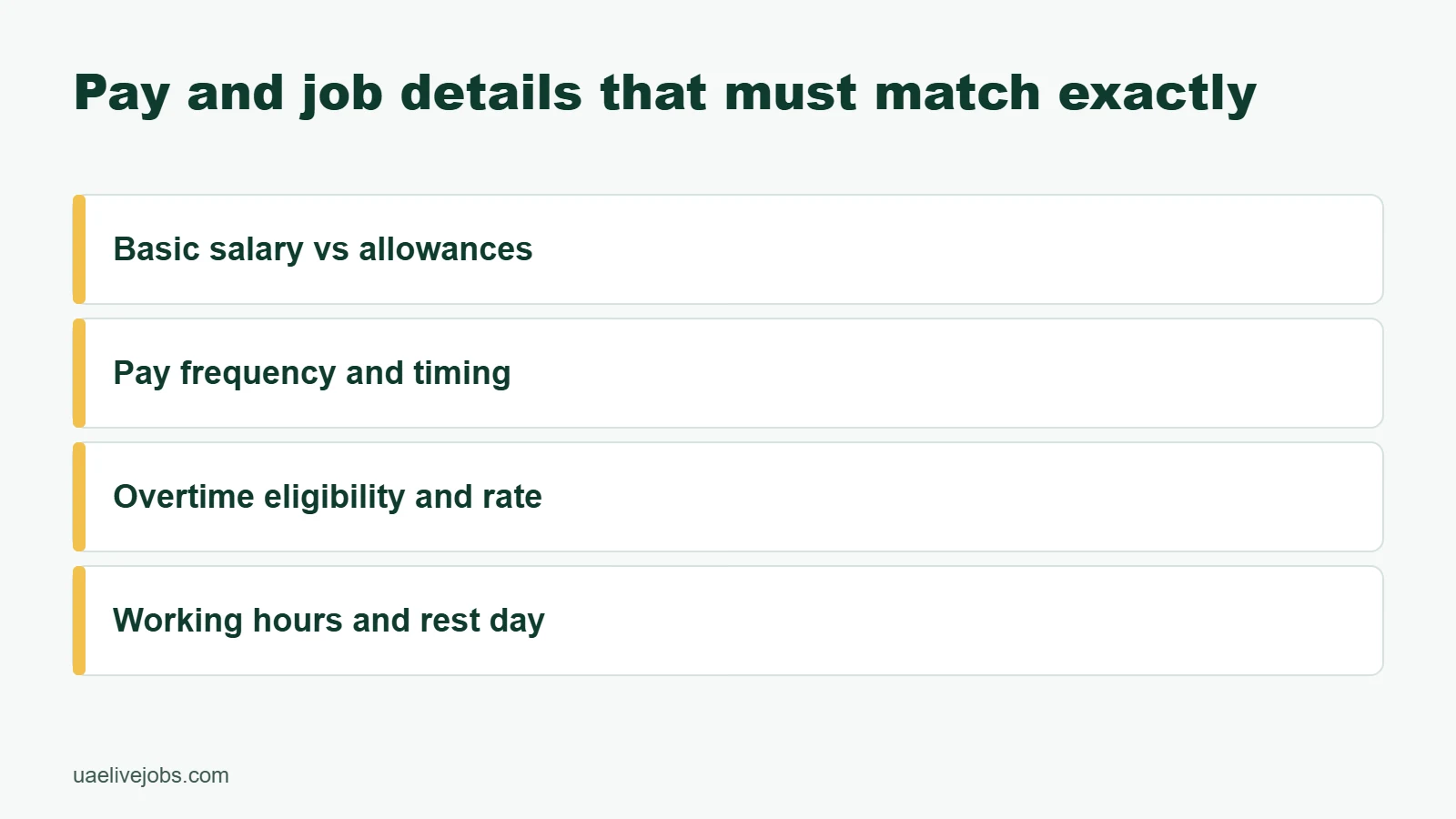
Pay and job details that must match exactly
Money and role details should match without “interpretation.” If HR says “it’s the same,” it should read the same.Use this as your line-by-line match list:
Basic salary vs allowances: Confirm the basic salary amount and each allowance (housing, transport, other). If the offer shows only a “package,” ask for the breakdown in the contract.
Pay frequency and timing: Monthly vs biweekly, and when salary hits your bank account. Also confirm the currency stated.
Deductions: Any agreed deductions must be written clearly, including reason and method. If it’s not agreed, it shouldn’t appear.
Commission: Check percentage, what counts as a sale, when it’s “earned,” and when it’s paid. A commission that’s “paid after client payment” is different from “paid on invoice.”
Bonus: If a bonus is mentioned, confirm criteria, timing, and whether it’s guaranteed or discretionary.
Overtime eligibility and rate: If your role involves long hours, you need clear terms. Some roles exclude overtime; don’t assume.
Working hours and rest day: Match daily hours, weekly days, and any rotating shifts. If your offer says “9 hours,” the contract shouldn’t say “as required.”
Job title and scope: The title should match, and the duties should not shrink your level. Watch for language that quietly turns a specialist role into “any tasks assigned.”
Work location and travel: City, site, and whether you can be moved. If remote or hybrid was promised, get it written.
Reporting line: It’s not just hierarchy, it affects targets, approvals, and performance reviews.
One detail many people miss: “total package” can hide a lower basic salary. That matters because end-of-service calculations often depend on basic pay, not the full package. If the offer sells you on a big number, confirm what portion is basic.
Time-based terms that change your risk if they are different
Time clauses decide how exposed you are if things go wrong. Even a small mismatch can change your exit options.Check these items carefully:
Start date and joining conditions: If your start date depends on visa approval, make sure the contract states what happens if there’s a delay.
Probation length: Confirm exact probation period and whether it can be extended. If it can, the contract should say how and when.
Probation notice rules: Notice during probation often differs from notice after probation. Match the exact number of days stated.
Contract duration: If it’s fixed-term, confirm end date, renewal terms, and whether early termination has penalties.
Notice period after probation: Match the number of days and any conditions like “payment in lieu” or “company may waive.”
Leave accrual start: Some contracts say leave starts after probation, others accrue from day 1. Make sure it matches what you were told.
Public holidays and weekly off: If the offer references standard UAE holidays, the contract shouldn’t reduce them through a vague policy statement.
End-of-service wording: Don’t accept unclear phrasing like “as per rules” without knowing which rules the employer means.
Final settlement timing: Your final pay timeline should be written, especially if you’ll rely on it to relocate.
Visa and onboarding timeline: Confirm who handles costs and the expected steps. If you want a clearer picture of the process after signing, see this job offer to UAE work visa process.
Finish this section with one extra scan: look for any clause that lets the employer change your location, shift, or role without your consent. Even if it’s “standard,” it should be limited and reasonable.
Red flags that mean pause, ask questions, or get the terms rewritten
Some clauses don’t look scary at first. They read “normal.” Then you realize they can cut your income, trap you in the role, or make it costly to leave.If you spot a red flag, don’t argue emotionally. Pause, ask for clarification, and request a rewrite. If they refuse, treat that as information about how they’ll act later.
Clauses that quietly reduce your pay or freedom
Watch closely for these patterns:Unpaid overtime expectations: The contract hints that long hours are “part of the job” without defining overtime rules. This often hits operations, retail management, and sales roles.Vague commission language: Phrases like “commission may be paid” or “as per policy” with no policy attached. If there’s no written rule, it’s not a promise.Discretionary bonus with no criteria: “Bonus at the company’s discretion” can still be fine, but don’t count it as income.Clawbacks and training repayment: Some companies ask you to repay visa, training, or onboarding costs if you resign early. If it exists, it must be clear: amount, time window, and triggers.Company policy overrides: A clause saying policies can change anytime, and the policy controls over the contract. This can let key terms shift later.Non-compete that’s too wide: Limits that cover large geographies, long periods, or broad industries can restrict your next job. Even if enforcement varies, fighting it later costs time and money.Penalties for early resignation: Be careful with “penalty” language that’s separate from normal notice requirements.Some clauses may not hold up the way the employer expects. Still, you don’t want to build your plan around a future dispute.
How to negotiate fixes without burning the offer
Keep it simple and professional. Your goal is clarity, not winning an argument.First, compare the offer and contract and write down mismatches. Next, pick your top three priorities (usually salary breakdown, notice and probation, and incentives). Then email HR with a clean request: updated contract wording, or a signed addendum that states the corrected terms.Also ask one direct question: which version will be used for official processing (MOHRE or the free zone authority)? You want the official record to match what you signed.You can adapt lines like these:
“Thanks for sharing the contract. I noticed a few differences from the offer letter. Can you please update the contract so both documents match before I sign?”
“The offer shows a housing allowance of AED X, but the contract lists a total package only. Please confirm the basic salary and allowances as separate line items.”
“Please confirm this signed version will be the same version used for the official work permit and visa process.”
Finally, get the final copy signed by both sides, and save it as a PDF. If the company makes changes after you sign, insist on a countersigned revision or addendum.
Check the basic salary in your MOHRE contract, because it is the figure used for gratuity. You can view your approved contract on MOHRE’s inquiry portal. Our gratuity calculator shows how much it adds up to over time. If your job is in skill levels 6 to 9, you may sign the contract at a Tawjeeh centre, so bring your offer to compare.
What to compare before you sign
A UAE offer letter sets expectations, but the employment contract sets the rules you live by. When the two don’t match, that gap is where most disputes start.Before you sign, run a fast final check: salary breakdown, probation and notice, hours and overtime, commission or bonus rules, leave, termination terms, and any special clauses (training repayment, non-compete, relocation). Ask for the final contract before you resign whenever possible, and keep signed copies of every version.Treat the signing stage like a seatbelt. You hope you’ll never need it, but you’ll be glad it’s there if something changes.
Farooq Malik
Farooq Malik is the founder and editor of UAE Live Jobs, an independent guide hub for people working in the United Arab Emirates. He researches and writes practical guides on labour rights, pay, visas, CVs and job applications, building each one on official sources such as MOHRE, ICP, GDRFA and the UAE government portal (u.ae). Every guide is checked before it's published and updated when the rules change. You can reach Farooq at info@uaelivejobs.com.