

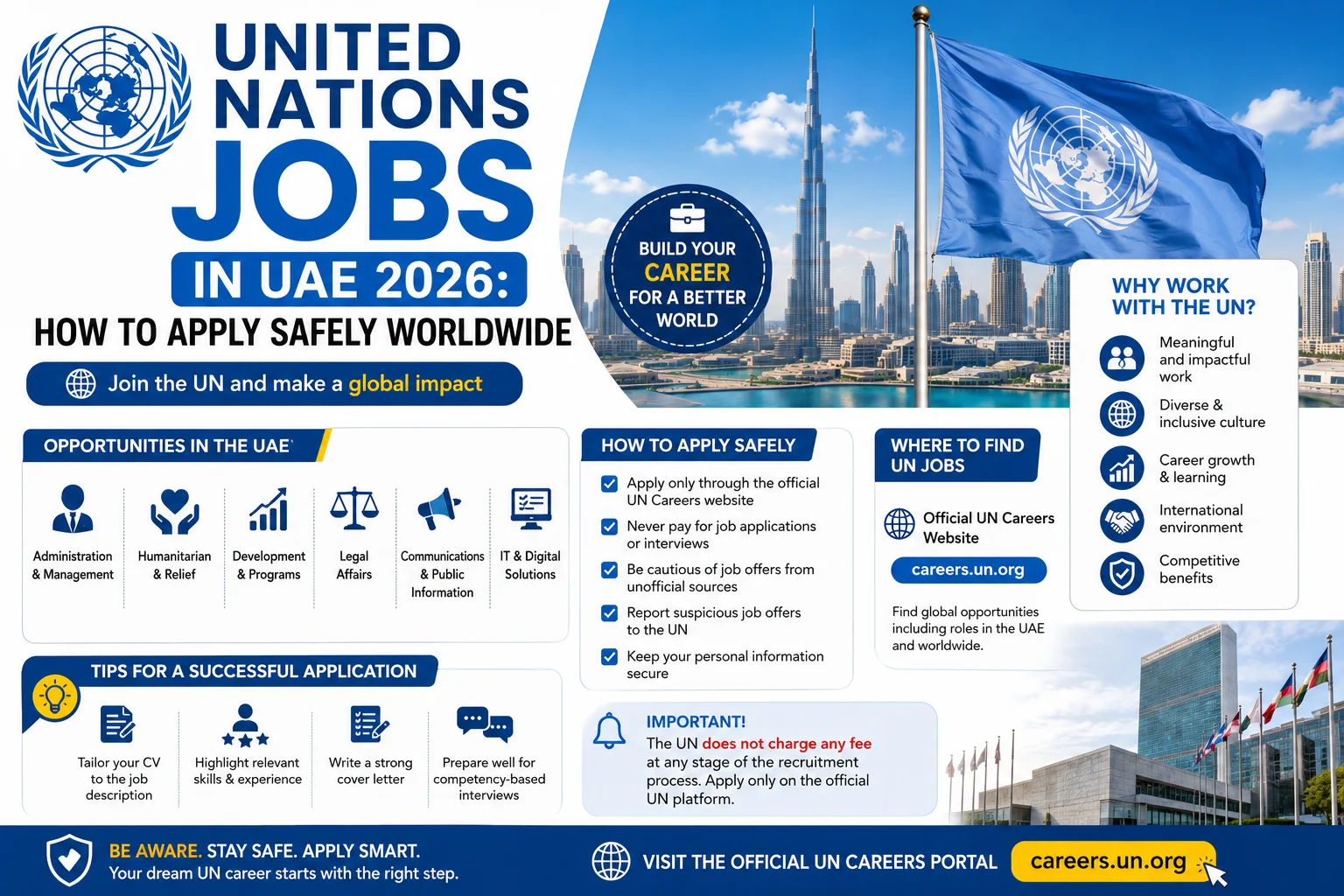
United Nations Jobs in UAE 2026: How to Apply Safely Worldwide
A United Nations career can place your skills behind humanitarian relief, human rights, peacebuilding, development, public health, administration, and global policy. United Nations jobs attract applicants because the work has a public-service purpose, yet selection is formal and highly competitive.
Openings change often across agencies, duty stations, and contract types. This guide explains job categories, country options, eligibility, compensation, the official application process, and ways to avoid recruitment scams. Always confirm a current vacancy through the official UN Careers portal or the hiring agency’s official careers page.
United Nations Jobs in UAE, UK, USA, Canada, Germany, and More
The UN recruits in many countries, not only at its best-known headquarters. A role may be based in Abu Dhabi or another UAE location, London or another UK office, New York, Washington, DC, Canadian offices, or German duty stations such as Bonn.
Opportunities also appear in Geneva, Nairobi, Vienna, Santiago, and country offices across Asia, Africa, Latin America, and the Middle East. Peacekeeping operations and humanitarian missions recruit for field assignments when operational needs arise.
The hiring organization matters. The UN Secretariat, UNICEF, UNHCR, UNDP, WHO, WFP, IOM, UN Women, and other entities use different systems, job levels, and contracts. Therefore, two jobs with similar titles may have different requirements, benefits, and deadlines.
Job families cover a wide range of work, including:
- Humanitarian affairs, program management, public health, and environmental policy
- Human resources, finance, legal affairs, communications, translation, and conference services
- Information technology, procurement, logistics, security, engineering, and administration
Current postings can move quickly, so don’t treat an old vacancy shared on social media as an active opening. Check the stated closing date and the official source before you spend time on an application.
Which UN career paths match your skills?
Professional and technical posts often require university education and relevant experience in a defined field. These roles include policy officers, economists, epidemiologists, legal officers, data specialists, and program managers.
Administrative and support positions can include office assistance, procurement support, finance operations, registry work, drivers, technicians, and language services. Some national officer posts are reserved for nationals of the country where the job is located.
Internships, consultancies, temporary appointments, volunteer assignments, and emergency deployments each have separate conditions. A consultancy may focus on one deliverable for a limited period, while a staff appointment usually carries a broader set of responsibilities.
Headquarters roles often focus on policy, reporting, governance, and coordination. Regional offices connect global priorities with local needs. Country programs handle implementation, while peacekeeping and humanitarian missions may require work in difficult operating conditions.
Match your education and experience to the duties in the announcement. A communications professional should look for roles involving media relations, public information, campaigns, or editorial work. A supply-chain specialist should focus on logistics, procurement, warehouse operations, or emergency supply roles.
What makes UN work different from a regular international job?
UN staff work with colleagues from many nationalities and professional backgrounds. Projects often involve governments, civil society organizations, donors, local communities, and other UN entities.
That environment can create broad professional exposure and opportunities to move between functions or duty stations. However, candidates must also be ready for structured recruitment, detailed written applications, possible relocation, and strict compliance with vacancy requirements.
Field work may involve security restrictions, frequent travel, or limited family options. The mission is meaningful, but applicants should assess the practical demands with the same care they give the job title.
A strong motivation statement cannot compensate for missing mandatory education, experience, or language requirements.
UN Job Eligibility, Qualifications, and Language Requirements
Eligibility for United Nations jobs depends on the vacancy. There is no single rule that applies to every agency, country, or contract. The vacancy announcement is the final authority on education, experience, nationality, language, and legal work conditions.
Many professional positions request a bachelor’s degree or an advanced degree in a related discipline. Relevant professional experience is usually required, especially for mid-level and senior posts. Some administrative, trade, health, security, or operational roles follow different standards.
Employers also assess writing ability, technical knowledge, teamwork, planning, communication, integrity, and commitment to UN values. Experience with multicultural teams can help, but applicants must show it through real work examples.
The UN’s six official languages are English, French, Spanish, Arabic, Chinese, and Russian. English or French is commonly required for many international posts, while a second official language may be an advantage. Country-office roles may also require a local language.
Nationality rules vary. International Professional posts may be open to candidates of many nationalities, while National Officer and General Service positions can have local nationality or residency requirements. Visa and work authorization rules also depend on the duty station.
Education and experience employers usually look for
Professional vacancies often ask for a degree in a field tied to the assignment, such as international relations, economics, law, public health, environmental science, accounting, communications, or information systems. Advanced degrees may reduce the amount of required experience for some posts, but only where the notice says so.
Count relevant experience carefully. If a posting requires project management, describe budgets managed, reports produced, teams coordinated, or services delivered. Generic claims such as “responsible for projects” give a recruiter little evidence.
Internships, volunteer work, and short-term assignments can strengthen an early-career profile. Still, they do not replace required professional experience unless the vacancy explicitly allows them to count.
Documents to prepare before you apply
Prepare your profile before a suitable role appears. Accurate records make it easier to meet a tight deadline without rushing details.
Keep these materials ready:
- A tailored employment profile with complete education and work history
- Degree records, professional certifications, and language details
- Verified employment dates, referee contact details, and relevant work samples
- A clear statement of interest or cover letter when the announcement requests one
Use accurate dates and explain career gaps briefly if needed. Check spelling in job titles, employer names, and degree information. Each application should reflect the duties of that vacancy, because a copied generic profile rarely shows a close fit.
UN Pay, Benefits, Contracts, and the Real Cost of Relocation
UN compensation is not a fixed global salary. Pay depends on the job level, duty station, contract type, hiring entity, and local conditions. Never accept a role based only on a salary figure copied from an unofficial source.
Staff appointments may include health coverage, paid leave, pension or retirement arrangements, family-related support, education assistance, and travel or relocation support. Some duty stations offer hardship or mobility-related allowances when conditions justify them.
Temporary appointments, consultancies, internships, and volunteer assignments can have very different benefits. A consultant may receive a daily or monthly fee but no staff pension. Internship and volunteer terms also vary widely by organization and location.
Before accepting an offer, check taxes, visa rules, housing costs, insurance coverage, schooling needs, and local transportation. A higher headline salary can lose value quickly in an expensive city.
How to compare a headquarters role with a field assignment
A headquarters role in New York, London, Bonn, or Geneva may offer stable office routines and close contact with policy teams. It can also come with high housing costs and competitive local services.
Field assignments can provide direct program exposure and may include allowances tied to the duty station. Yet they may involve security limits, demanding travel, restricted family arrangements, or temporary living conditions.
Review the duty station classification and every contract term. Salary alone does not show the full value or challenge of an offer.
How to Apply for United Nations Jobs Safely and Correctly
Start with the official UN Careers website or the official careers page of the agency named in the vacancy. You can also use job boards to find leads, but verify every listing at its original source before applying.
Follow this application path:
- Create a profile in the required official recruitment system.
- Search by location, organization, job family, level, or keyword.
- Read the full vacancy notice, including education, experience, language, and nationality requirements.
- Check the closing date and time zone, then complete every required field.
- Upload documents only when the official system requests them.
- Submit before the deadline and save a copy of your application.
After submission, the process may include eligibility screening, written exercises, technical assessments, competency-based interviews, reference checks, and final selection. The timeline can vary considerably by entity and role.
If the official careers page provides an application guide, download it before you apply. It can clarify how to complete your profile, attach documents, save drafts, and submit correctly.
How to write a stronger UN application
Show results rather than repeating duties. Use a simple situation, action, and result structure. For example, explain the operational problem, what you did, and the measurable result when numbers are available.
Mirror required skills honestly. If the role asks for stakeholder coordination, report writing, data analysis, or emergency operations, connect your own experience to those duties with clear examples.
Also describe work with international or multicultural teams when it is relevant. Review every response before submitting. Meeting minimum requirements does not guarantee an interview because UN recruitment attracts strong candidates worldwide.
How to spot fake UN job offers and recruitment fees
The United Nations does not charge applicants for applications, interviews, processing, training, placement, or any other stage of recruitment. It also does not request advance payments, bank passwords, or sensitive financial details.
Treat urgent payment demands, unofficial agents, suspicious social media accounts, and email addresses that do not match the organization as warning signs. Requests for passport copies or bank data before a verified offer also require caution.
Verify the vacancy on the official site and report suspected fraud through the organization’s stated reporting channel. Third-party job boards are not automatically fraudulent, but they should only point you toward the original announcement.
United Nations jobs in the UAE, UK, USA, Canada, Germany, and other locations differ by agency, duty station, and contract. Choose a job family that fits your record, then read the official vacancy notice line by line.
Prepare a tailored profile, confirm that you meet every stated requirement, and submit before the deadline. Most importantly, never pay a recruitment fee. Apply only through verified official channels and only for roles you can support with clear, accurate evidence.
